
How We Audit a Home Services Website in 5 Minutes Flat

Before we walk through exactly how we audit home service websites step by step, one thing needs to be clear upfront.
If you don’t want to do this yourself, we’ll do it for you.
Our Quick Audit Service delivers this exact analysis, plus a working session with one of our team members to walk through the findings, prioritize fixes, and help implement what actually drives leads.
Now, for those who want to see how the engine works, here’s the real process.
Why our audits don’t feel like agency theater
Most agencies love pretending their work is powered by wizardry, secret sauce, and “deep proprietary insights.”
We don’t.
Our advantage is systems: systems clear enough that AI Apprentices can follow them, powerful enough that home-service owners feel the results, and automated enough that AI does most of the heavy lifting.
This is the new reality.
We don’t just audit websites. Our agents fix them.
Everything below reflects the actual tools and workflows we run at Local Service Spotlight and inside the AI Apprentice program.
Step 1: AI agents analyze the site
We start with Christopher, our custom GPT agent trained on our entire Content Factory playbook.

What used to be a vague “give me SEO tips” prompt is now a structured, repeatable workflow. The agent loads the site, crawls the core service and city pages, evaluates lead flow, flags missing trust signals, checks technical and local SEO issues, and prioritizes fixes based on ROI.
This alone replaces hours of manual review.
Step 2: The raw audit is auto-organized into a clean canvas
AI output is useful.
Agent-organized output is transformational.
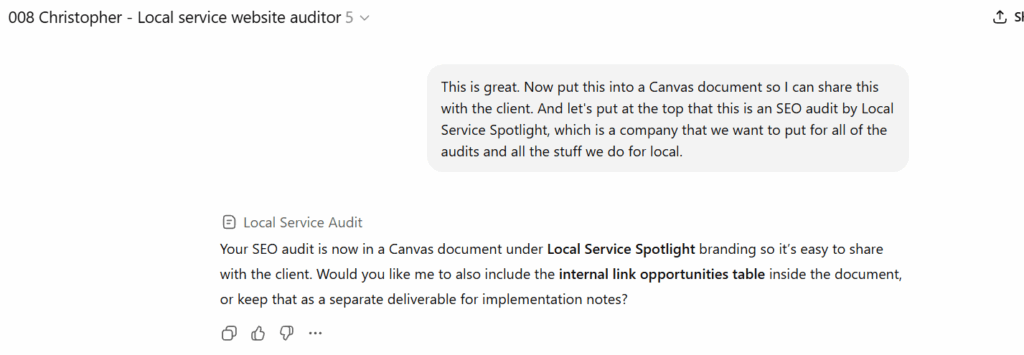
The findings are pushed into a canvas organized by SEO, content, trust, and EEAT, local SEO, technical issues, and calls to action. Everything is visually scannable and written in plain language.
This is the difference between an audit a contractor ignores and one they actually understand.
Step 3: Agents layer in real keyword + pages data (Ahrefs)
A real audit needs real numbers.
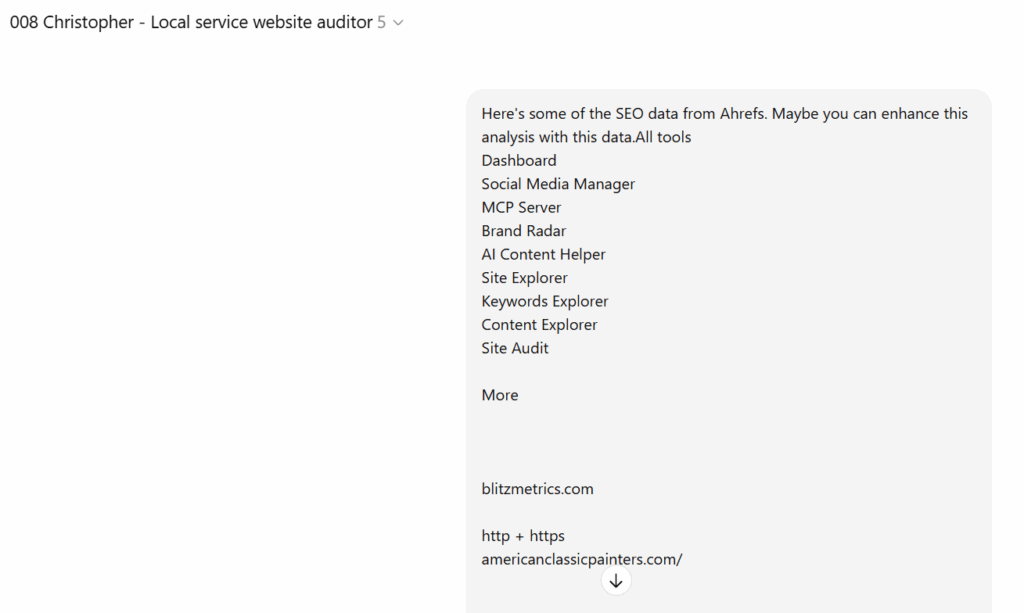
The agent pulls live search data, including top-performing pages, striking-distance keywords, internal linking opportunities, competing URLs, and underutilized pages sitting just outside page one.

Those insights are blended directly into the canvas so the audit becomes a strategy grounded in measurable data, not opinions.
Step 4: A one-page executive summary for busy owners
No one running a home service business wants a 12-page audit report.
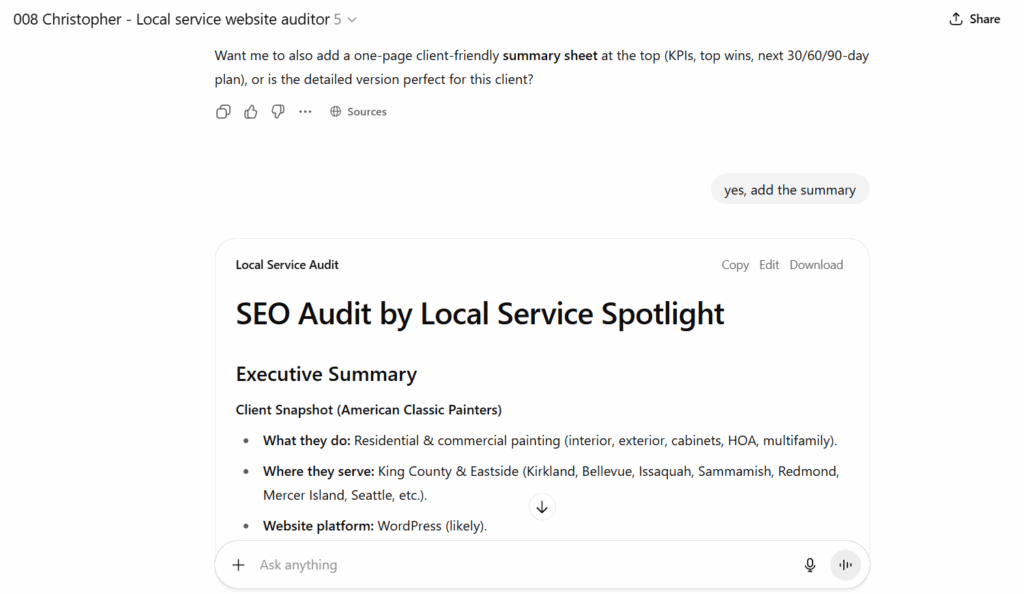
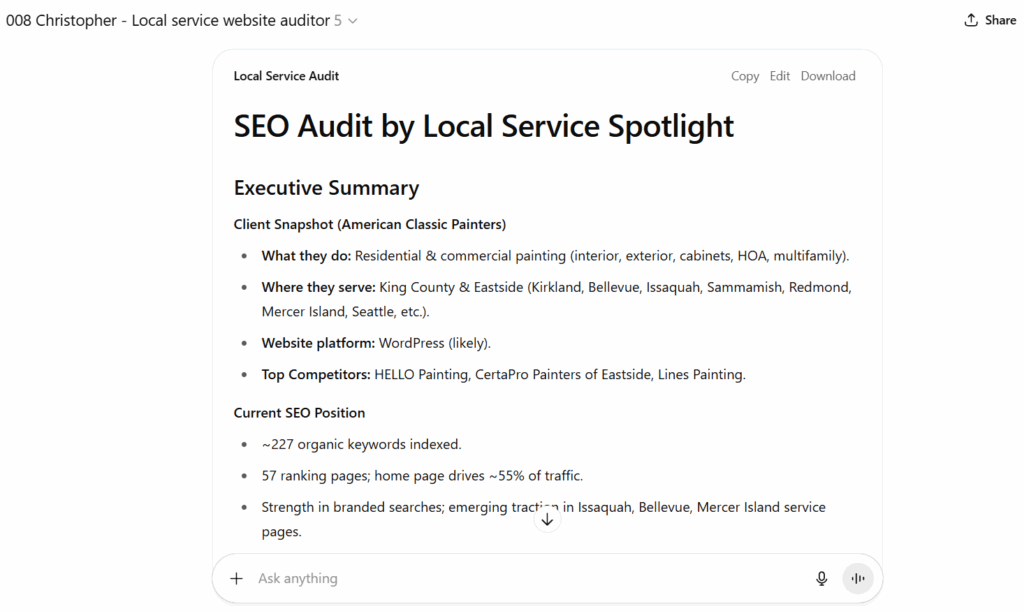
So the agent produces a one-page executive summary that answers three questions: what’s working now, what’s missing, and which two or three fixes will deliver the highest ROI fastest.
This becomes the roadmap for the strategy or onboarding call.
Step 5: Everything is packaged before the meeting
The full audit, canvas, summary, data overlays, screenshots, and checklists are compiled into a clean, professional PDF before the meeting ever happens.
At the same time, onboarding automation kicks in. Access is granted, expectations are set, and the owner shows up to the call already oriented and seeing value instead of asking, “So… what are we looking at?”
Step 6: The agents don’t just recommend fixes—they implement them
This is the part that didn’t exist even six months ago.
Once implementation is approved, agents execute. Pages are optimized and published. City pages are written. Schema is generated. Titles and metadata are rewritten. Internal links are added. Cannibalization is cleaned up. Real photos are turned into content. Videos are repurposed into YouTube, articles, snippets, and GBP updates.
Humans still supervise, but the heavy lifting is automated by agents trained on our own SOPs inside a shared ChatGPT Business workspace.
What used to require an entire team now runs as a system.
Real audit examples across industries
Why this process actually matters
The old agency model collapses the moment business owners see the truth.
AI handles the grunt work. Humans provide judgment, proof, and authenticity.
One job becomes content. One video becomes an ecosystem. Every fix compounds EEAT. Every owner becomes Googleable.
It’s infrastructure for scaling results and for creating real jobs by giving AI Apprentices systems instead of busywork.
Quick Audit QA checklist
1. Capture business context: Company name, services, service area, top cities, website URL, mission, differentiators.
2. Identify priority pages: Home, service pages, city pages, gallery/jobs, blog hub, contact.
3. Benchmark against 3 local competitors.
4. Scan key pages: Lead blockers, CTA placement, phone visibility, forms, trust badges, reviews, warranties.
5. Identify 5 lead-blocking issues tied to exact URLs.
6. Produce 3 conversion hypotheses.
7. Evaluate EEAT: Owner bio, licenses, media, certifications, project case studies.
8. Local SEO: NAP consistency, embedded map, GBP link, city/service structure, schema.
9. On-page basics: Titles, H1s, meta descriptions, header hierarchy, internal links, alt text.
10. Draft improved titles/metas where needed.
11. Build internal link map: Service ↔ city pages, gallery → service pages, blogs → money pages.
12. Propose 20+ specific in-content link placements.
13. Standardize city pages: Unique intro, neighborhoods, benefits, internal links, local project case, CTA.
14. Recommend swapping stock images for real ones + captions.
15. Add or repair JSON-LD: LocalBusiness, Service, FAQPage.
16. Review blog alignment: Remove junk, 301 irrelevant posts, consolidate hubs.
17. Use Ahrefs data for striking-distance opportunities.
18. Create a “Top 5 ROI Opportunities” list.
19. Produce a clean, scannable Canvas with Impact/Effort scoring.
20. Final verification pass: No hallucinations, all screenshots included, anchors natural, links correct, at least one conversion win prioritized.