Why pay for a program when you can get AI training for free on YouTube?
Because you want your young adult to be mentored by the best, be in a structured program with accountability, and because you want to shorten the duration to achieve competency.
Information is free now. The basics are easy to find.
What’s not free is turning that information into real business growth — fast.
Metrics: what changed in leads, calls, jobs, revenue, and content output
Analysis: why it changed
Action: what we’re fixing or testing next
Your young adult runs real marketing, reports what happened, and improves it week by week until the numbers move.
The loop is always: execute → measure → coach → improve → execute again.
What You’re Paying For #2: Access
Inside the Academy, access means:
Experienced coaches.Dennis Yu and the team review your young adult’s real marketing work and show them how to make it stronger.
A clear path. They know what to focus on first, what to ignore, and what “good” looks like.
Fast feedback. Instead of guessing, they get answers and direction while they work.
A room of builders. Other apprentices are doing the same kind of work, so your young adult learns faster and stays motivated.
Masterminds with other AI Apprentices. They trade what’s working, break down problems, and push each other to deliver better results.
Dennis has 30+ years of experience and has worked with brands like Nike, Starbucks, Rosetta Stone, the Golden State Warriors, and more. That level of coaching helps your young adult avoid expensive wrong turns and reach competency faster.
What You’re Paying For #3: AI Infrastructure
A major part of the program cost is the AI infrastructure we provide.
Each AI Apprentice receives access to a full year of our shared ChatGPT Business account, including pooled credits and the custom GPTs and agents we’ve built for real marketing work.
This matters because:
Apprentices don’t start from scratch. They use proven custom GPTs for planning, writing, auditing, and reporting.
Output is faster and more consistent. Shared business-level access removes usage limits and friction.
Work is easier to review and improve. Everything lives inside one workspace that coaches can see and guide.
The cost is covered by the program. Apprentices don’t have to manage subscriptions, credits, or setup.
This AI setup directly increases how much quality work apprentices can produce each week.
The specific AI tools included may evolve over time. We currently use ChatGPT Business because it’s the best option for our workflow today. As models, platforms, and pricing change, we reserve the ability to upgrade, replace, or remove specific tools so apprentices always have access to the most effective AI systems available.
How the Apprentice Program Works
Your young adult builds skill by working inside a live local service business (often yours).
What they do inside the program:
Create and publish content using the proven Content Factory workflow.
Run simple local campaigns to turn that content into leads.
Improve offers and follow‑up so inquiries turn into booked jobs.
Apply coach feedback to the next round of work.
They’re getting real reps on a real business, with real coaching. That’s how they build skill that shows up as results.
Quick Recap
Training is free because information is free.
You’re paying for three things: results, access, and AI infrastructure.
Together, that helps your business get more leads, calls, and booked jobs.
This video was filmed in Las Vegas during a conference weekend. Four of us sat down—young adults who are actually doing the work every day—to talk through a question we hear constantly: “Should I go to college, or should I do something else first?”
Our answers aren’t identical because our paths haven’t been identical. That’s the point. There isn’t one correct route. There is a smart first move, though: build skills that travel with you.
We All Took Different Paths—and We’re Still Moving Forward
Here’s what that looks like in real life for the four of us in this video:
Same table, same conversation, different decisions. Nobody is “behind.” Nobody is locked out of a good career. What separates people early isn’t the label of student or non‑student. It’s whether they’re gaining real ability to create value.
Using modern tools to speed up research, writing, and creative production.
Turning customer reviews and job photos into content people respond to.
Improving websites so visitors turn into calls and booked jobs.
Running simple ad campaigns and tracking what’s working.
Communicating with business owners and following through on deadlines.
Building repeatable workflows such as the content factory so that results aren’t random.
These skills transfer into almost any lane—whether you end up in business, tech, sales, operations, or entrepreneurship.
Real Ways People Use the Program
People come into High Rise Academy with different starting points, and the same skills end up helping them in different ways. That’s because the Academy sits in the middle of a two-sided market: on one side are local service businesses that need real marketing help, and on the other side are young adults who need real experience. When both sides show up, everybody wins—businesses get growth work done, and apprentices get reps that actually matter.
Some apprentices work directly with local service businesses through the Academy. They learn our systems, build campaigns, and get daily reps on real client work.
Others start close to home by running marketing for their parents’ local service businesses. They’ll fix a website, post content, set up ads, and organize reviews—then see what happens when consistent marketing meets real operations.
Some take that family-business experience and turn it into outside work. That step—from “helping at home” to “helping clients”—is a common bridge.
A good example we talked about is Ethan Murphy. He began by doing marketing for his parents, then applied the same playbook to the fencing niche. Within a few months he had picked up five or six fencing clients and was delivering results fast. He’s basically building a niche agency around that skill set.
Those are four distinct, real outcomes from the same skill set. Same training, different applications—because the two sides of the market keep feeding each other: businesses create the problems worth solving, and apprentices build the skills by solving them.
Why Skills First Makes the College Decision Easier
College can be a good move for some people. It can also be the wrong move for others at a given time.
The problem is that most people are asked to choose before they’ve done enough real work to know what they want.
Skills fix that.
When you can produce useful work:
You have proof of what you’re good at.
You can earn while you learn.
You can switch directions without starting from zero.
You walk into college (if you go) with context instead of guessing.
That’s why we keep saying this program can be an internship, a first job, a career start, or a way to level up a family business. It’s not a narrow track. It’s a skill-builder.
What To Do Next If You’re Still Unsure
If you’re undecided about college, that’s normal. Most people are being asked to choose before they’ve done enough real work to know what fits. Getting real reps first makes the decision a lot clearer.
If you want to learn these skills in a hands-on way, then the High Rise Academy might be right for you. You’ll work on real local service business campaigns, learn modern marketing systems, and build a portfolio that makes your next decision easier.
We have a chronic problem in our materials, and it’s not subtle. It’s stock art.
You know exactly the species:
Stick-figure crowds that look like they escaped from ClipArt rehab.
Fake-smiling business people who have clearly never run an actual business.
Random gradients someone tossed in because “the page needed something.”
Stock art isn’t just inauthentic; half the time it’s not even relevant. It’s visual filler. And despite calling it out in threads, updating training, and telling people loudly not to use it, stock art keeps sneaking back in like a raccoon raiding the dumpster behind Applebee’s.
But there’s a deeper issue. And it has nothing to do with design skills.
The real problem: No experience = no expertise
Stock art shows up when someone doesn’t actually understand what they’re trying to communicate.
It’s easier to paste a cute icon than it is to:
Map out a funnel from a real campaign.
Show the real metrics.
Pull real screenshots.
Explain the real logic behind the system.
And this is where we run headfirst into EEAT, specifically the first E: Experience.
Google rewards content grounded in firsthand proof. So do real users. When you throw in stock art, you’re broadcasting the opposite: “I don’t have anything real to show you.”
Nothing demolishes credibility faster.
Stock art = evidence of no actual doing
Here’s the pattern we see all the time:
We talk about performance benchmarks. We break down funnels. We show TikTok metrics. We emphasize real examples, real screenshots, real campaigns.
Then someone uploads… a blue stick-figure holding hands with 11 of its closest stick-friends.
Why?
Because stock art gives the illusion of completion without demonstrating any experience.
And without real experience, you don’t have expertise. Without expertise, you can’t teach. That’s the whole point of Learn → Do → Teach. The order matters.
What belongs in our materials instead
Only things that reflect real work done by real practitioners:
Simple diagrams that match how the system actually works.
These aren’t decorations. They’re evidence. Evidence of experience. Evidence of understanding. Evidence of actual EEAT.
A simple rule:
If you wouldn’t show it to a paying client, don’t put it in our training.
Why stock art hurts our brand
Let’s be blunt:
❌ It destroys authenticity.
People can smell generic content a mile away. It instantly lowers trust.
❌ It’s usually irrelevant.
Stock art rarely reinforces a concept. It’s just visual noise.
❌ It signals “I don’t understand this.”
This is the killer. When someone fills space instead of providing clarity, the entire training degrades.
❌ It hurts our EEAT.
Google prefers content with real images/video because it demonstrates firsthand experience. Stock art does the exact opposite.
❌ It links us to low-quality sites.
Right-click search any stock image and you’ll find it on:
crypto scams.
random spam blogs.
some guy’s homemade “entrepreneur motivation” poster from 2012.
Not the company we want to keep.
How we fix this, permanently
The answer isn’t “find better art.”
The answer is do real work, then document it.
If you’re contributing to training, you’re not a decorator. You’re a practitioner teaching from experience. That means:
If you can’t explain the metric, don’t include an image
If you don’t know where something belongs in the funnel, ask
If you’re unsure whether an image fits, it doesn’t
If you feel tempted to use stock art… shut the laptop, take a breath, and delete it
Our materials must come from actual experience — not Shutterstock and not AI-generated Web 1.5 clip art.
The bottom line
Stock art has no place in materials meant to build trust, teach systems, or prove competence.
Use real images. Use real video. Use real proofs of work.
Not because it “looks nicer.” Because it satisfies the first E in EEAT — Experience. Without that, nothing else matters.
Our brand deserves better. Our training deserves better. And the people learning from us deserve materials that are accurate, authentic, and grounded in real experience.
Let’s publish content so real, so credible, and so obviously practitioner-driven… that nobody ever reaches for stock art again.
If you’ve landed on this page, it’s because we featured you in one of our articles which means you just picked up a high-quality, contextually relevant backlink from HighriseInfluence.net.
Nice work. Most sites never get even one legit mention.
About our site (and why this link matters)
HighriseInfluence.net is still growing (our Domain Rating is DR7 at the moment) but don’t let the number fool you.
In SEO, context and relevance often beat raw power.
Our site sits squarely in the personal branding, authority building, and reputation growth space.
We publish content tied to entrepreneurs, local service pros, agencies, and thought leaders.
Every outbound link we give is intentional and topic-aligned, not random spam or profile links.
That means the link pointing to you is:
✔ Do-follow. ✔ Clean and natural. ✔ Surrounded by relevant content. ✔ Coming from a real brand with real activity.
And yes, Google notices that.
Why a DR7 link still helps
Would you rather get a DR63 backlink? Sure. Who wouldn’t?
But here’s the reality most SEO “gurus” won’t tell you:
A single contextually aligned link often moves rankings more than a higher-DR link that’s off-topic.
Your new link from Highrise Influence passes:
Topical authority.
Entity association (your name/business connected to ours).
Relevance (Google loves niche-aligned sources).
Trust signals from a legitimate business publishing original content.
These help your site’s SEO no matter what your current DR is.
How to see the impact
If you use tools like Ahrefs, SEMrush, or MOZ, you’ll notice:
New referring domain.
Increased backlink count.
Potential movement in your keyword rankings over the next few weeks.
Stronger entity signals for your brand.
If your site is under DR20, every high-quality backlink is a big deal. The early ones move the needle the most.
Share the win
You earned a legitimate feature; don’t keep it quiet.
Post on your social channels, tell your audience you were mentioned, and link back to the article. Not only does it help your SEO even more, it amplifies your authority.
Keep rising
Congrats again on being featured.
Keep building, keep showing up, and keep stacking wins like this.
Over 80% of the internet is spam and your website is guilty until proven innocent.
Google decides who’s innocent using EEAT—experience, expertise, authority, and trust.
As a search engine engineer at Yahoo! 25 years ago, my job was to protect the algorithm from spam sites or info that wasn’t relevant from appearing on your results page.
25 years later Google still implements roughly the same guidelines.
Google’s guidelines for sorting what websites were relevant for a long time was EAT, which stands for expertise, authority, and trust.
In layman’s terms, if you want your site to benefit from SEO you have to demonstrate you’re an expert in your field, you’re authoritative on the subject your website is about, and show that enough people trust you.
The benefits for doing this was an increase in your site’s rankings, allowing you to rank higher on the search terms you care about and to give your site more “SEO Juice”. If your website is guilty until proven innocent, implementing EAT was your proof of innocence.
A few months ago Google changed EAT to EEAT, adding an extra E for experience.
Now – Google wants to see more stories of who you’ve helped and videos of how you’ve helped them. It wants to give priority to businesses who overwhelmingly prove they do what they say they do, in the area they say they do it in.
Many “SEO Experts” will claim that they have some secret black hat formula for increasing site rankings. But real search engineers like myself know that implementing proper EEAT is the most important “SEO trick” you can do for your website to grow your SEO.
Whether it’s to get more calls for your local service business, get more sales for your book, or get your name out there so you can get a Google Knowledge Panel, this is how you do it.
Here’s how to implement EEAT with examples, so you can do it too.
Expertise
When you’re sick, why do you visit a doctor’s office instead of self-diagnosing?
It’s because they know more about health and the human body than you do.
The reason why anyone trust anyone else is because they’ve done or seen something before, know what it is, and know how to fix it.
The reason I speak at over 50 conferences a year is because of that level of expertise which has taken decades to generate in the field of digital marketing.
If you visit my website, DennisYu.com, you can see that expertise in the articles I write and the problems I’ve helped solve. Many local service business do this in the form of FAQ’s.
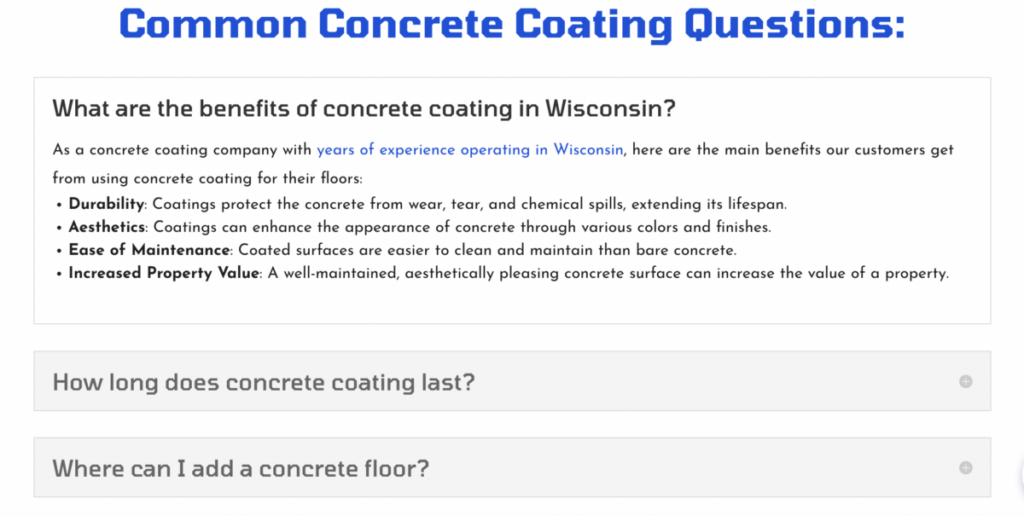
Take for example my friend Greg Beebe, who runs Excel Concrete Coatings. What he’s done is take PAA (people also ask) questions on google related to concrete coatings and answered them directly on his website.
Excel Concrete Coatings answering Google PAA questions
This is just one of the many ways you can demonstrate expertise to Google and to your customers.
What’s something that you document on your website that few others know in your field? What makes you an expert in your line of work?
PAA questions are a great way of demonstrating expertise, but truly think about what questions you can answer on your website that show you’re an expert.
Experience
Using the doctor analogy, would you trust a surgeon to give you heart surgery who’s never done the operation before? Probably not.
So why then, would you pay an agency or local service business who has no proof they’ve done anything successful before?
Google (and the people who you want to buy your offer) want you to show overwhelming experience that you do a good job at what you say you do, in the area you say you do it in. The best way to demonstrate experience for Google and your clients is with stories.
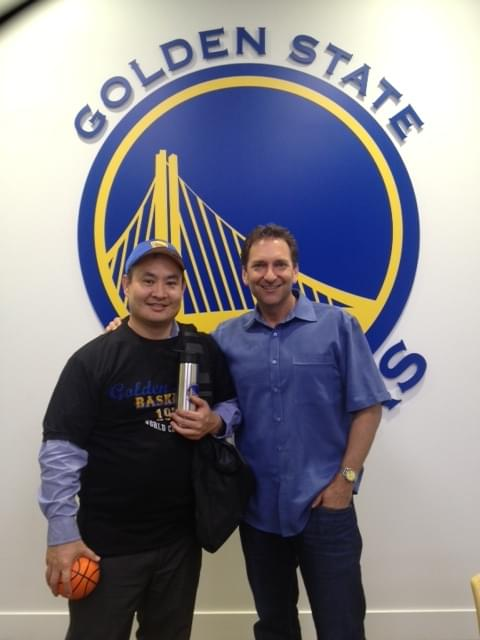
For example, if you Google “Dennis Yu” you can find stories about how I’ve ran ads for the Golden State Warriors, how I’ve spent $1 Billion on Facebook Ads, and how I’m training up young adults to be successful agency owners.
Dennis Yu at Golden State Warriors Headquarters
One way you can do this as a local service business is to talk about other customers and document your work.
Take our friend at Oasis IV Therapy in Tampa. They run a mobile IV therapy clinic and one thing they do a great job at is taking photos and getting feedback from their customers.
Oasis IV Therapy With Their Customers
Google and you operate in roughly the same way. You want to see images, stories, and especially videos of a business doing what they say they do.
There’s no such thing as too many videos or too much documentation of your work.
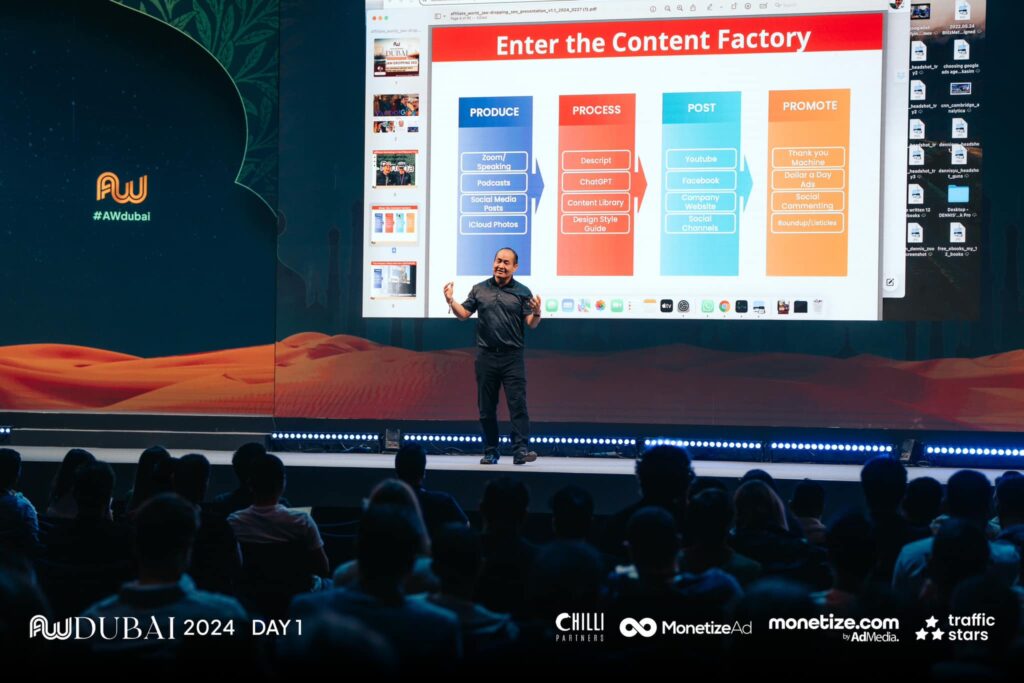
Ideally, you should be using the Content Factory process to document these stories and repurpose them across all platforms.
For example, if you record a podcast with someone more influential – you should also be repurposing that into a blog post.
We want our stories and experience to exist on as many platforms as possible.
Your job as it relates to EEAT is to document your work on your website, GMB, and socials for Google and your customers.
Authority
The best way to leverage authority for your personal brand or business is to borrow someone else’s.
When you see an image of me debating Mark Zuckerberg on CNN, that alone gives me tons authority I didn’t have before.
These are content, people, and properties. Each do a great job at helping the other.
Content is what you put out into the world. Whether that’s articles like this one, short form videos on Instagram and Facebook, or long form videos on YouTube.
Content is authority we can link to and reference.
Just like how this article is content we can point to for anyone asking about EEAT, you should have existing content which explains what things are.
Despite what internet gurus some claim, you don’t need to have a million followers and drive a lambo to show authority. You just have to have documented proof.
People is the cornerstone of authority and arguably the most important.
Dennis Yu with Rehan Allahwala in Pakistan
Relationships run the world. Networking with others that share your mission is a great way to elevate your authority while promoting others at the same time.
This doesn’t have to be a parasitic relationship. Being seen, working on projects, and being available for others means you can help them.
That leads to authority from others since you’re working closely on a shared mission.
For local service businesses, this means using a geo-grid and talking to others in your industry.
For example, if you’re an HVAC company in Boston you should be sharing links, interviewing, and working with another HVAC company in LA.
This tells Google (and your customers) that you’re authoritative since you can borrow the authority from others in your industry.
Lastly, it’s properties. This can be your website or business itself.
Having something real that’s documenting in Google and for your clients means that you’re a real person or business doing real work.
Trust means that others can trust you with their time and money.
There’s certain trust markers that you should aim for your personal brand or business.
For example, our client TLS Insulation has over 1,000 combined 5-star reviews on the Google business profiles.
What this means, is that enough people have used their service and gotten positive results that the signal to Google is incredibly strong.
Books are another way to demonstrate trust since, since so few have them on authoritative subjects.
And with Dollar a Day on Amazon, you can get your amazon book to bestseller status fairly easily.
Dennis Yu showing his book on TikTok Advertising
A good practice is asking yourself, “Why do people trust my business?”. And then answering the question in a way people can understand.
The beautiful thing about EEAT is how every component feeds into the other.
By networking with others, your boosting your authority, which in turn helps your trust.
The thing that’s most important here are stories.
The AI doesn’t have your stories. It doesn’t have your moments – where you’re in Austin eating tacos with your friend or hanging out and eating steak.
Because AI is not human, with those stories, Google is able to determine whether it’s content that deserves rank or was it content that was just created for the search engines.
You may have heard of the difference between synthetic content vs real content. I can pick a photo or a video from my personal phone gallery – Google knows exactly what device I’m using, where the media was taken – it has all sorts of information.
This is what Google’s looking for – a signature of trust.
When I take these stories that started out as photos or videos, they can then be turned into blog posts.
If you start with your actual content, ChatGPT like any tool or any technology is an amplifier of what you already have. If you start from nothing, nothing times a million is still nothing.
So if you start with a seed of stories and friendships that we have, we can add pictures and videos to enhance the initial seed, the nugget that I put in initially. That’s where people are getting it wrong with AI.
Using AI to auto generate everything is where Google will eventually catch you. As Bill Gates has said, AI is a multiplier of what you already have.
So it’s what you put in the machine – you’re going to get 10 times more of it.
Before we walk through exactly how we audit home service websites step by step, one thing needs to be clear upfront.
If you don’t want to do this yourself, we’ll do it for you.
Our Quick Audit Service delivers this exact analysis, plus a working session with one of our team members to walk through the findings, prioritize fixes, and help implement what actually drives leads.
Now, for those who want to see how the engine works, here’s the real process.
Why our audits don’t feel like agency theater
Most agencies love pretending their work is powered by wizardry, secret sauce, and “deep proprietary insights.”
We don’t.
Our advantage is systems: systems clear enough that AI Apprentices can follow them, powerful enough that home-service owners feel the results, and automated enough that AI does most of the heavy lifting.
This is the new reality.
We don’t just audit websites. Our agents fix them.
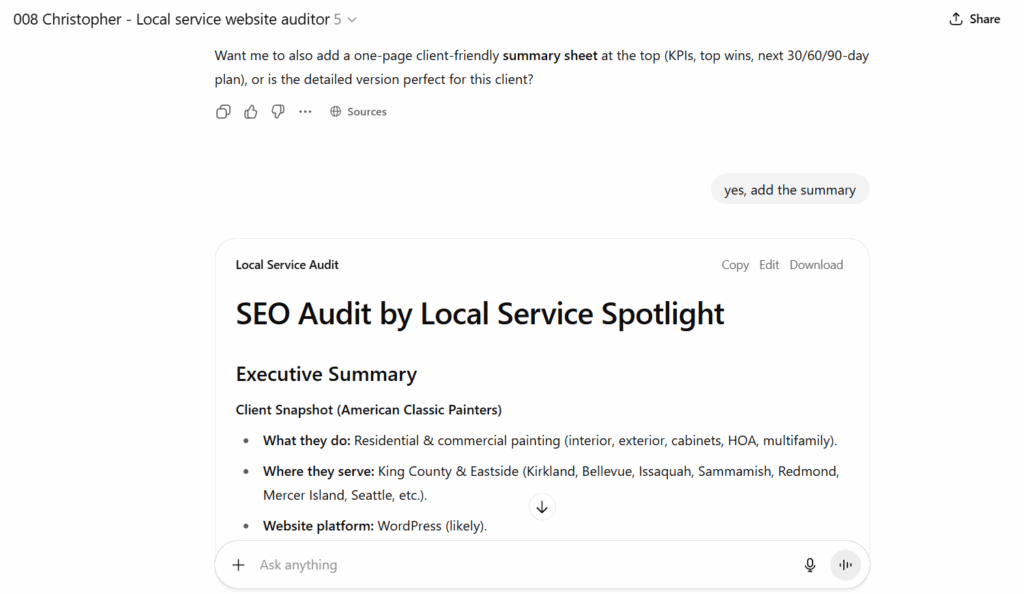
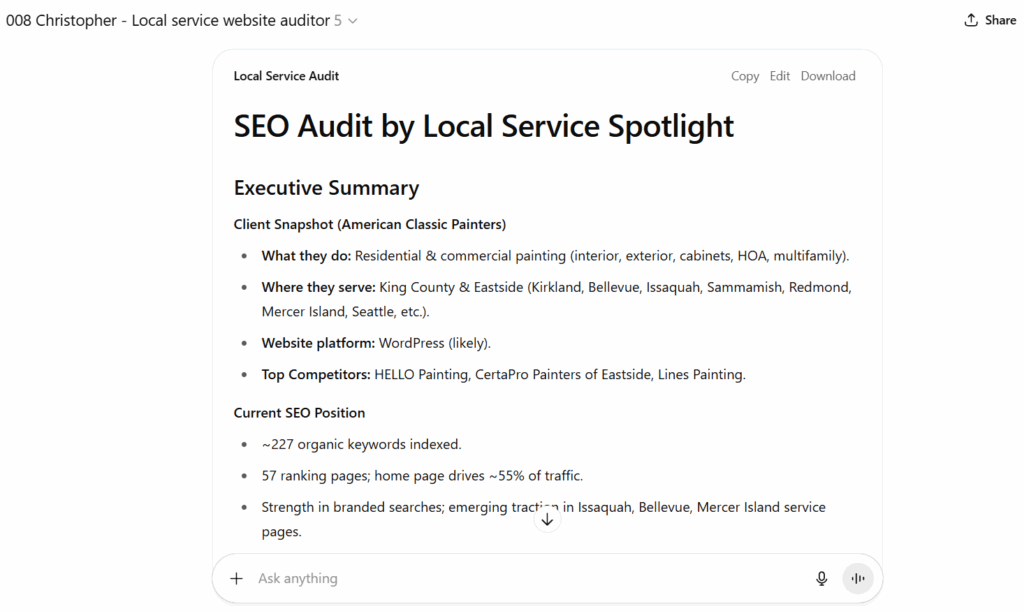
We start with Christopher, our custom GPT agent trained on our entire Content Factory playbook.
What used to be a vague “give me SEO tips” prompt is now a structured, repeatable workflow. The agent loads the site, crawls the core service and city pages, evaluates lead flow, flags missing trust signals, checks technical and local SEO issues, and prioritizes fixes based on ROI.
This alone replaces hours of manual review.
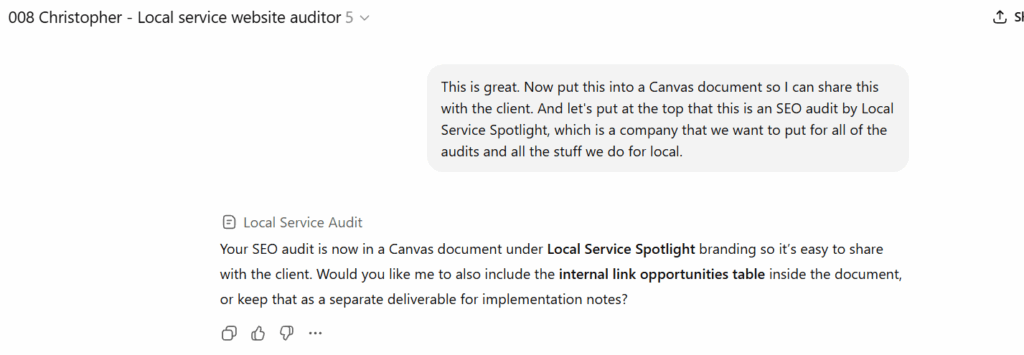
Step 2: The raw audit is auto-organized into a clean canvas
AI output is useful. Agent-organized output is transformational.
The findings are pushed into a canvas organized by SEO, content, trust, and EEAT, local SEO, technical issues, and calls to action. Everything is visually scannable and written in plain language.
This is the difference between an audit a contractor ignores and one they actually understand.
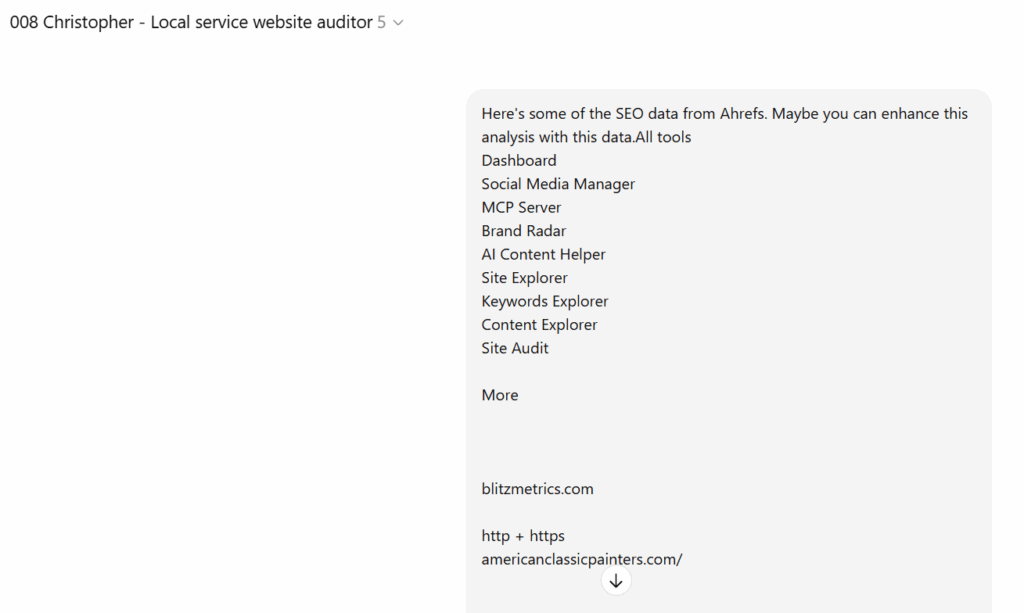
Step 3: Agents layer in real keyword + pages data (Ahrefs)
A real audit needs real numbers.
The agent pulls live search data, including top-performing pages, striking-distance keywords, internal linking opportunities, competing URLs, and underutilized pages sitting just outside page one.
Those insights are blended directly into the canvas so the audit becomes a strategy grounded in measurable data, not opinions.
Step 4: A one-page executive summary for busy owners
No one running a home service business wants a 12-page audit report.
So the agent produces a one-page executive summary that answers three questions: what’s working now, what’s missing, and which two or three fixes will deliver the highest ROI fastest.
This becomes the roadmap for the strategy or onboarding call.
Step 5: Everything is packaged before the meeting
The full audit, canvas, summary, data overlays, screenshots, and checklists are compiled into a clean, professional PDF before the meeting ever happens.
At the same time, onboarding automation kicks in. Access is granted, expectations are set, and the owner shows up to the call already oriented and seeing value instead of asking, “So… what are we looking at?”
Step 6: The agents don’t just recommend fixes—they implement them
This is the part that didn’t exist even six months ago.
Once implementation is approved, agents execute. Pages are optimized and published. City pages are written. Schema is generated. Titles and metadata are rewritten. Internal links are added. Cannibalization is cleaned up. Real photos are turned into content. Videos are repurposed into YouTube, articles, snippets, and GBP updates.
Humans still supervise, but the heavy lifting is automated by agents trained on our own SOPs inside a shared ChatGPT Business workspace.
What used to require an entire team now runs as a system.
When people ask what I’ve learned from building High Rise Influence (HRI), I don’t think about a class or a book. I think about the last few months of doing the work and getting real feedback from real clients.
I’ve learned more about business and communication in these past few months than I did in the years before—because this time the learning came with real stakes.
Here’s what’s stood out most, with examples straight from our experience.
Team Communication Is Learned on the Job
One of the best early lessons came from Jack Wendt. He told us how, when he was new to team email threads, he kept hitting “Reply” instead of “Reply All.” So only one person saw his response while everyone else waited for an update that never came.
It’s a simple mistake, but it shows what school doesn’t cover:
How quickly you have to adapt when other people depend on you.
You don’t get good at teamwork by reading about it. You get good at it by working with people who need you to be reliable.
School Zoom Calls Aren’t Client Calls
I mentioned in the video that we had Zoom during quarantine. But that was basically practice for showing up, not for leading.
On school calls:
Cameras were off.
Nobody was driving a result.
You could be half-present and still “attend.”
Client calls in LSS and HRI are the opposite. We’re meeting with business owners who trust us with their online reputation. We’re helping them claim and improve their Google Knowledge Panels, clean up search results, and make sure their brand shows up the right way.
That has forced me to learn, fast:
How to lead a call with a clear objective.
How to ask the right questions instead of guessing.
How to explain actions in plain language.
How to follow up without being chased.
Setting Up a Company Teaches Business at a Real Level
While we’ve been building HRI, we’ve also been building the structure behind it. That meant learning things we’d never touched before.
We’ve had to work through:
Equity splits.
Vesting schedules.
How many shares to issue.
How to think about investors and long‑term incentives.
Talking about equity in a classroom is one thing. Making decisions that affect the future of the company is another.
Client Relations: Trust + Ownership + Delivery
Clients don’t just hire us for tasks. They hire us to protect and grow their reputation. That changes your mindset.
What client work has taught me:
Trust is earned through delivery, not promises.
Speed matters because clients hate silence.
Ownership matters because excuses don’t help anyone.
Results matter because clients care about ROI.
We’ve seen this up close. People pay us because they believe we’ll take care of them. If something goes wrong, we fix it. If we miss something, we own it. That responsibility sharpens you.
Getting Paid to Learn Business Beats Paying to Learn Business
This is one of the biggest advantages of what we’re doing.
When you’re building in real time:
Feedback comes immediately.
Mistakes cost something, so you stop repeating them.
Wins show you what to double down on.
That’s why the learning curve is so steep.
Real Work Brings Real Rooms
A few weeks ago, Sam and I were on a call with a billionaire helping him claim and strengthen his Knowledge Panel.
That moment hit me because it wasn’t about age or titles. It was about whether we could help.
What I took from that:
If you can solve a real problem, you belong on the call.
Competence travels faster than credentials.
Opportunities show up when you’re already producing value.
Teamwork Also Means Knowing When to Do It Yourself
We talked about this in the video: working on a team doesn’t always mean pushing work to someone else. Sometimes the best move is to take something from start to finish yourself because it’s cleaner and faster.
What we don’t do is park tasks in “later” forever. Keeping projects moving is part of being dependable to your team and your clients.
Mentorship Compresses the Learning Curve
We’ve had Dennis Yu mentoring us through all of this. Having someone who’s already operated at a high level point out what matters, what doesn’t, and why saves you years.
It also sets the tone for how we want to lead: learn something, apply it in real work, then teach it forward.
Where This Leaves Me
Being part HRI has made business feel less like a concept and more like a skill set you build daily. Communication, accountability, client care, equity, execution—it all gets learned in the same way: by doing the work and being responsible for the outcome.
Want to Learn These Skills Through Real Work?
If you want to build the same skill stack we’re talking about—through real projects, real clients, and real mentorship—check out High Rise Academy.
It’s designed to help young adults (and anyone hungry to grow) turn real work and real reviews into campaigns that convert.
“What do we actually do here?” is a fair question—especially when you hear us talk about helping local service businesses build their brands. This video was a quick, honest rundown from the Local Service Spotlight (LSS) and High Rise Influence (HRI) team about what that help looks like in real life and who is doing what.
LSS and HRI work together as partners. Our job is to take the everyday work local pros are already doing—jobs completed, customer stories, before‑and‑after wins, and five‑star reviews—and turn that into consistent online visibility and campaigns that bring in more calls.
The Problem We’re Solving for Local Service Businesses
Plumbers, HVAC techs, roofers, and other local service owners don’t usually have time to be full‑time marketers. They’re running routes, answering phones, managing crews, and taking care of customers. That means their online presence often lags behind the quality of their work.
Our teams step in so the business owner doesn’t have to learn five tools, edit videos at midnight, or guess at ads. We build the systems, the content, and the campaigns around their real‑world service so they show up where customers are searching and scrolling.
What Each Role Contributes:
Sam: Engineering, AI Tools, and Automation
Sam McLeod’s focus is speed and leverage. He builds websites and automations, using AI tools and code so repetitive tasks take less time. When content can be repurposed quickly and websites update smoothly, clients get faster turnaround and faster results.
This fits the Content Factory approach BlitzMetrics teaches: create once and repurpose into multiple assets without adding extra workload.
Luke: Facebook Ads, Creative, and Client Care
Luke Crowson handles the marketing side that clients actually see. He creates the ad creatives that go into Facebook campaigns, helps manage spend, and keeps improving the client’s website and online presence.
He also emphasized something most agencies ignore: client care. Meeting with clients, making them feel heard, and staying close to their goals is part of performance. The ads and the website are supposed to make a homeowner feel, “Okay, these people will take care of me.”
When we do this right, we’re applying the same Goals‑Content‑Targeting (GCT) foundation BlitzMetrics lays out—get clear on the goal, build the right content, and aim it at the right audience.
Jack: High Rise Academy Training and the LSS–HRI Bridge
Jack Wendt’s explains how HRI connects directly into the work LSS does through High Rise Academy. HRI runs training while partnering with LSS on tools and processes. Sam helps build the tools students use, and Jack makes sure students know how to apply them.
The students learn to make a local business owner more visible, build better ad campaigns, and drive more calls and revenue for whoever they’re representing. It’s practical training with real businesses, not theory.
Dylan: Content Repurposing, Websites, Ads Support, and Training
Dylan Haugen’s role has been wide by necessity. Over the last six to seven months he’s done content repurposing with AI tools like Descript, worked on client websites, helped create content for local businesses, supported Facebook ads with Luke, and trained Academy students weekly.
He also made a helpful point for anyone watching: the tools we use are intentionally simple. If you’ve ever edited a video before, tools like Descript make repurposing fast once you know the system.
Jack’s Close: Credibility and Invitation
Jack ends by giving real context on the team’s experience: Dylan has generated over 100 million views across his social channels, Luke is known for delivering results with ad spend (including work with Ad Astra), and Sam is the engineer making the backend run smoothly. The invitation was simple—if this kind of work sounds interesting, check out LSS, HRI, and the Academy.
Why LSS and HRI Are Stronger Together
Watching the roles side‑by‑side makes the partnership obvious.
LSS builds and refines the operational system: AI tools, websites, ad creative, and client delivery. HRI multiplies that system by teaching it through High Rise Academy, so more trained people can support more local businesses.
It’s one pipeline from real service work to real marketing output—supported by engineering, creative, and training all moving in sync.
The Big Takeaway
Local service businesses don’t need to reinvent a brand from scratch. They already create proof every day in their jobs and customer outcomes. Our job at LSS and HRI is to capture that proof, repurpose it into content people actually watch, and put it behind campaigns that convert into calls.
If you’re looking for a clear path, real skills, and a way to put them to work on projects that matter, High Rise Academy could be a great fit.
When people first hear about High Rise Influence, the reaction is almost always the same: “There’s no way this is real.” Free access to training, mentorship from leaders like Dennis Yu, and hands-on experience helping real local service businesses sounds impossible—especially for young adults still figuring out their path.
But the video we filmed together tells a different story. Four of us sat down for a real, honest conversation about where we’re at in life, what this program has done for us, and why we believe it’s worth sharing.
This article breaks down what we shared in that conversation and why the High Rise Influence model works so well for young adults.
Why Young Adults Are Uniquely Positioned to Succeed
In the video, we talked about how each of us founders lives a completely different life. One of us is married and in school. One is 27 and trying to find clear direction. One is 20 and already confident in his path. And then there’s me—I’m still in high school, and I’m a professional dunker.
Even with those differences, we share something important: we grew up surrounded by technology.
A lot of local service business owners haven’t had to live inside social media and modern tools the way we have. It’s not that they’re incapable—it’s just not their world. For young adults, using Instagram, TikTok, YouTube, and now AI tools feels natural. We recognize patterns in interfaces and content without thinking about it.
That’s a massive advantage.
Inside High Rise Influence, we lean into that advantage instead of ignoring it. We plug those natural instincts into structured systems like the Content Factory, which breaks down how to market to actually drive results. When you combine what you already know with a clear framework, your skills become valuable very quickly.
Real Experiences We Shared
In the video, each of us shared where we were in life and what led us into this program.
I’m still in high school, and I’m a professional dunker. I travel across the country competing in dunk contests and creating content around that journey. On paper, it looks like I shouldn’t have much time for anything else.
But that’s exactly why my story matters here.
For most of my life, I made social media content just for myself—filming dunks, editing clips, posting on Instagram, and learning what caught people’s attention. I never thought of that as a “professional skill.” It was just something I did because I loved it.
When I got involved with High Rise Influence, I realized those same skills were incredibly valuable to local service business owners. The same instincts I use to pick the best angle on a dunk or to edit a hype clip help me decide what makes a strong testimonial, a compelling ad, or a short that stops people from scrolling.
That’s when it clicked: what feels normal to me can be life-changing for someone’s business.
How High Rise Influence Helps Young Adults Find Purpose
In our conversation, one of the guys talked about hitting 24 or 25 and suddenly asking himself, “What am I actually doing with my life?” That moment hits harder than most people admit.
I’ve seen versions of that same feeling in a lot of young adults—drifting through school, changing majors, trying random jobs, or scrolling all day because nothing feels meaningful.
Purpose didn’t show up for me in some huge, dramatic way. It came from being put in a position where my skills were useful to someone else.
Inside High Rise Influence, purpose looks like:
Helping a local business owner who genuinely needs support
Seeing your work turn into leads, reviews, and real results
Being trusted with responsibility and held accountable
Working alongside other young adults who are aiming higher than “just get by”
Real progress comes from doing real work, learning from your mistakes, and slowly realizing, “I’m actually good at this—and it matters.”
Direction isn’t something you wait around for. You build it through deliberate practice and real work.
Digital Skills Young Adults Already Have
If you’re a young adult reading this, there’s a good chance you already have your own version of the skills needed in this space. You grew up in a digital world—using social media, creating and consuming videos, learning new tools quickly, and navigating technology as second nature.
Most of us don’t even realize how much we’ve picked up just by living online: understanding what makes content engaging, recognizing patterns in how platforms work, and adapting to new features and trends without thinking too hard about it.
Young adults are also surprisingly good at reasoning with AI tools. Because we’re used to technology evolving fast, things like prompting, experimenting, and iterating feel natural. Those instincts translate directly into this work—helping local businesses tell their stories, produce content, and run campaigns that actually perform.
All of these everyday digital habits become valuable when they’re applied inside a clear process with real clients.
A Community Built on Real Work, Not Hype
We’re very clear inside the program: this is not a “get rich quick” scheme.
We’re not promising overnight success or crazy income screenshots. What we’re offering is:
Real work with real local businesses
Systems and frameworks that have been tested
Mentorship from people like Dennis and the rest of the BlitzMetrics and High Rise teams
A community of young adults who are serious about building something
In the video, you can see how much we genuinely enjoy working together. That’s not acting. We joke around, challenge each other, and push each other to do better—not because we’re trying to impress anyone, but because we actually care about the work and the people we’re serving.
How to Get Involved
If you’re a young adult and any of this resonates with you—feeling directionless, wanting to use your existing skills for something that matters, or just wanting a path that isn’t “go to school and hope it works out”—then this is worth exploring.
High Rise Academy is the training path where young adults like me get real-world experience, build portfolios, and learn how to run campaigns the right way.
If you’re looking for direction, purpose, and a place to put your skills to work in a meaningful way, High Rise Academy might be the right next step for you.
Young people often ask whether it’s realistic to start doing meaningful work while they’re still in high school or just stepping into college. In this conversation, the founders of High Rise Influence shared how we did exactly that as young entrepreneurs—and how other young adults can follow a similar path.
The message is straightforward: when a young person is given a real opportunity and the support to act on it, their confidence begins to match their potential.
For readers who want to understand the broader frameworks behind turning conversations and videos like this into written assets, BlitzMetrics has public resources such as their Blog Posting Guidelines, the Content Factory process, and many other pieces of content creating for the purpose of teaching young adults how they can become a successful AI Apprentice.
From Doubt to Belief Through Opportunity
In the video, the founders talk about how each of us went from not believing in ourselves to realizing that we could actually build a career. That shift came from being given chances to learn, practice, and see real results.
We described how opportunities to work, grow their personal brands, and gain experience helped us move from uncertainty to genuine belief in our capabilities.
For young entrepreneurs, we pointed out that the main limitation usually isn’t age, background, or starting skill level—it’s the way they think about themselves.
What High Rise Influence Offers Young Entrepreneurs
Our team at High Rise Influence explained that we have programs and courses designed to help young adults launch their careers. One of the core ideas we stressed is that the educational content itself is free.
All the courses and information are available at no cost. The only thing someone might pay for is direct access: live weekly coaching, guidance, and being able to report progress to people who have already walked the path.
We also highlighted that this access includes time with Dennis Yu, who has over 30 years of experience in digital marketing. Having that kind of guidance is a major advantage for someone just starting out.
Starting Young: Real Ages, Real People
I’ve been doing similar work since I was very young, and I started doing this specific kind of implementation about a year before the video was recorded, when I was 17.
Since then, I’ve brought multiple friends into the same system, also at age 17. I’ve also brought in my younger brother, who started at 15 and was 16 at the time of the conversation.
We emphasize that these younger participants were able to pick up the workflows quickly, which reinforces our message that young people can do this when the process is clearly laid out.
Using AI Tools as a Personal Assistant
A recurring theme in our conversation is how AI has made learning and execution easier for young people. We talked about using ChatGPT as a kind of personal assistant.
We also mentioned actions like taking screenshots of tasks and asking AI questions about them, and using the Atlas browser assistant to ask questions directly in the browser.
Instead of getting stuck on unclear instructions or unfamiliar tools, we showed how AI can help break things down, explain steps, and keep work moving forward.
Helping Local Service Businesses with AI
When the founders answer the question, “What do we actually do?”, we explained that we use AI tools to help local service business owners and entrepreneurs build their personal brands.
Our work involves:
Making videos
Repurposing existing content
Structuring content so that Google can recognize the person or business as an entity it can trust
They note that they’ve done this for landscapers, HVAC companies, and professionals in the fitness industry. The same approach can be applied across many kinds of local service businesses.
The result is a win on both sides: local businesses get help showing up credibly online, and young people get a structured way to learn and contribute.
How This Fits Into a Larger Training Ecosystem
The methods discussed in the video align with broader systems used in the BlitzMetrics ecosystem, such as the Content Factory and process-driven training. High Rise Influence builds on these ideas with a specific focus on young entrepreneurs.
The founders describe a path where young adults can:
Build their personal brands
Learn how to support local service businesses with AI-assisted workflows
Get guidance from people who have executed in the field for many years
For those who want to explore the specific opportunity mentioned in the video, learn more about the High Rise Academy, and how you can begin your path as an AI Apprentice.