While exploring Germany’s iconic Neuschwanstein Castle, Dennis Yu and Jack Wendt recorded an episode of the High Rise Influence Podcast focused on helping established entrepreneurs build the online authority they deserve. In their conversation they explained that too many founders have real-world success but no digital footprint to match.
The duo shared specifics on how to earn a Google Knowledge Panel, including:
Documenting and structuring your accomplishments, awards, media features and press mentions so Google’s algorithms can verify your authority.
Building genuine backlinks and encouraging customer reviews to strengthen domain authority and signal credibility.
Auditing your existing online presence to identify gaps and inconsistencies across social profiles, websites and directories.
Creating a content plan that highlights your expertise through articles, interviews and appearances on authoritative sites.
They also outlined what High Rise Influence’s $6K Authority Panel package entails: a comprehensive audit of your digital footprint, development of an authoritative biography and supporting content, creation of high-quality citations, and submission to Google for Knowledge Panel eligibility. This service is designed for entrepreneurs who have already built successful businesses offline and want their online presence to reflect that accomplishment.
If you’re a founder who treats $6,000 as a small investment in your personal brand and you’re ready to upgrade your digital reputation, apply for a High Rise Influence Google Knowledge Panel Package today.
If you’re tired of vague “consulting” promises and want a repeatable blueprint for building a service agency that actually scales, this candid conversation is for you.
Dennis Yu and Jack Wendt pull no punches as they share how High‑Rise Influence helps 7‑ and 8‑figure founders earn a Google Knowledge Panel — the digital stamp of legitimacy most gurus can’t deliver. They reveal why clarity and proof matter more than hype, why you must draw a line on who you serve, and how to create an operations playbook that lets you hire and train without reinventing the wheel each time.
Highlights include:
Why “customizable” beats “custom” — and how to productize services without becoming a cookie cutter.
The hard truth about clients who think they’re the exception: you can’t make a beef Wellington out of baloney.
Real numbers: thousands of AI bots (from Claude, ChatGPT, and others) hitting their content, turning free education into actual leads.
How to leverage AI, social snippets and small ad spends to attract the right people — and repel the wrong ones.
Lessons from plumbing and HVAC agencies: focus on one niche, own your proof, and watch referrals snowball.
If you’re ready to stop selling air and start delivering results that even Google recognizes, hit play. Then let us know in the comments: what’s the one thing holding your agency back from scaling?
We’re looking forward to our call and to helping you claim your Google Knowledge Panel and get verified on Google! This one‑pager outlines exactly what we need from you so our meeting runs quickly and smoothly and we can get your panel claimed on the first attempt. Please read carefully and have everything ready for the call.
For anyone who hasn’t been sent this article, here’s a quick overview: we work with individuals and brands whose online presence has been recognized by Google as credible enough to receive an official entity within the Knowledge Graph — the data source behind Google Knowledge Panels. Our team hosts guided calls to help these clients verify their identity and successfully claim their panel.
Goal: make the claim/verification call quick and successful. Please gather the items below before we meet.
Time estimate: If you come prepared with all the required materials, the call should take about 10–20 minutes; without them, it may extend to 30–45 minutes, which is why we ask that you carefully review this list and have everything ready before we meet.
Who Should Be on the Call
The person whose Knowledge Panel we’re claiming should ideally be present on the call. This is because Google requires identity verification through personal documentation, and the individual must be logged into their own Gmail account during the process.
However, if a representative joins on their behalf, that person must:
Have all materials listed in this document (ID selfie, profile screenshots, supporting links, etc.)
Be logged into the Gmail account of the individual whose Knowledge Panel is being claimed
1) Identity & ID Photo (Required)
What to bring:
One selfie of you holding your government photo ID.
File types: .jpg / .jpeg / .png / .pdf
Must be true
Your face and the ID are fully visible and in focus.
Name on the ID matches the legal name you provide.
Text on the ID is readable (good lighting; avoid glare; don’t mirror/flip the image).
You may black out sensitive details (national ID number, home address, date of birth) as long as your name, photo, and document type are visible.
Google states it deletes the document within ~30 days after verification.
For each profile you want linked in your panel (we suggest 5 social media accounts or sites), provide (a) the URL and (b) a screenshot proving you control it. Make it obvious that you’re logged in and have edit/admin access.
Examples of acceptable screenshots
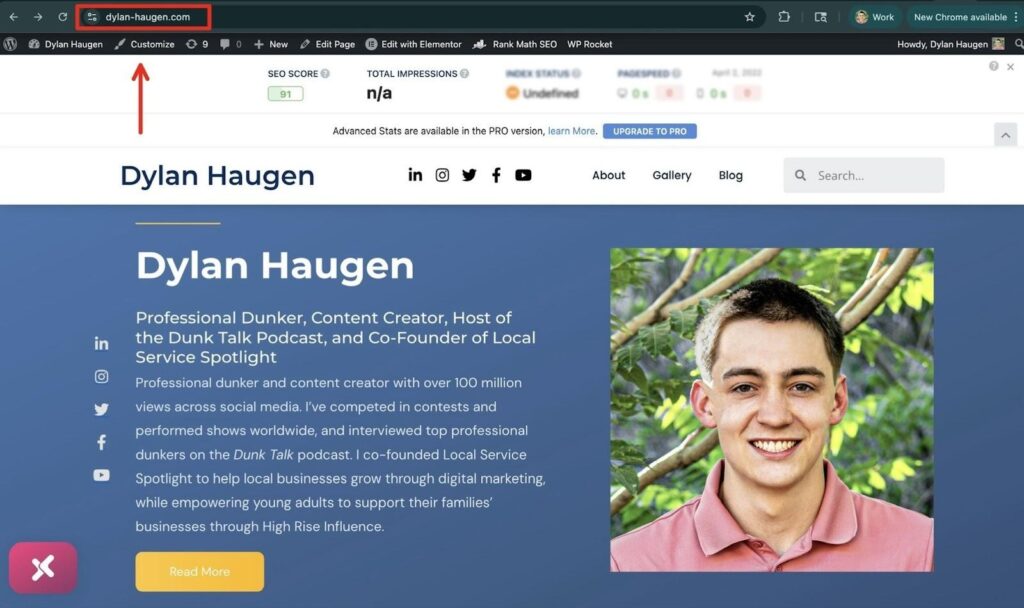
Website: WordPress (or other CMS) dashboard with site name visible.
Example for personal site
LinkedIn: Your profile while logged in (show the Edit controls or “Me” menu).
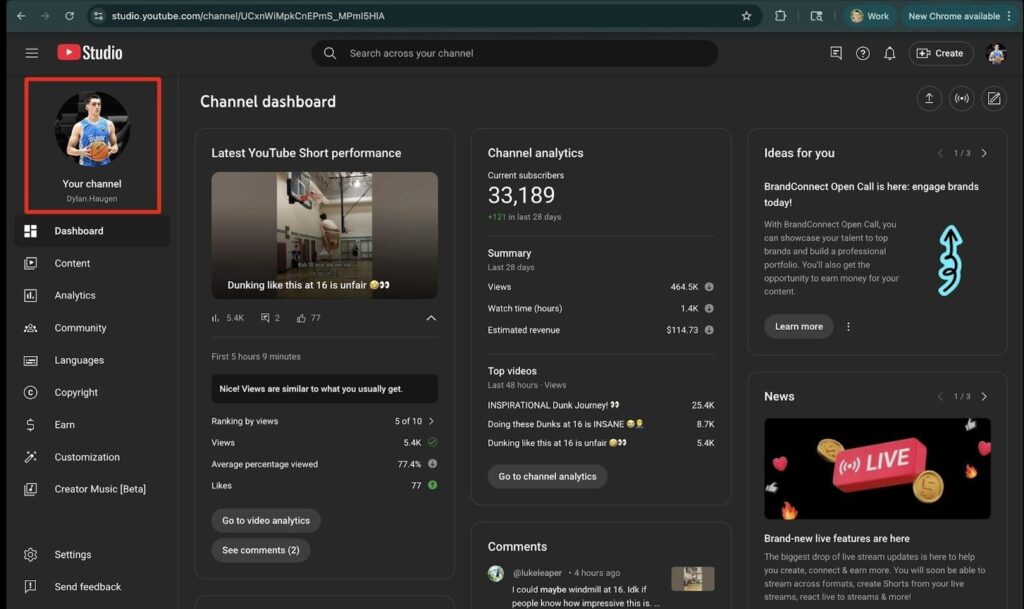
YouTube: YouTube Studio dashboard.
Example for YouTube – within Studio
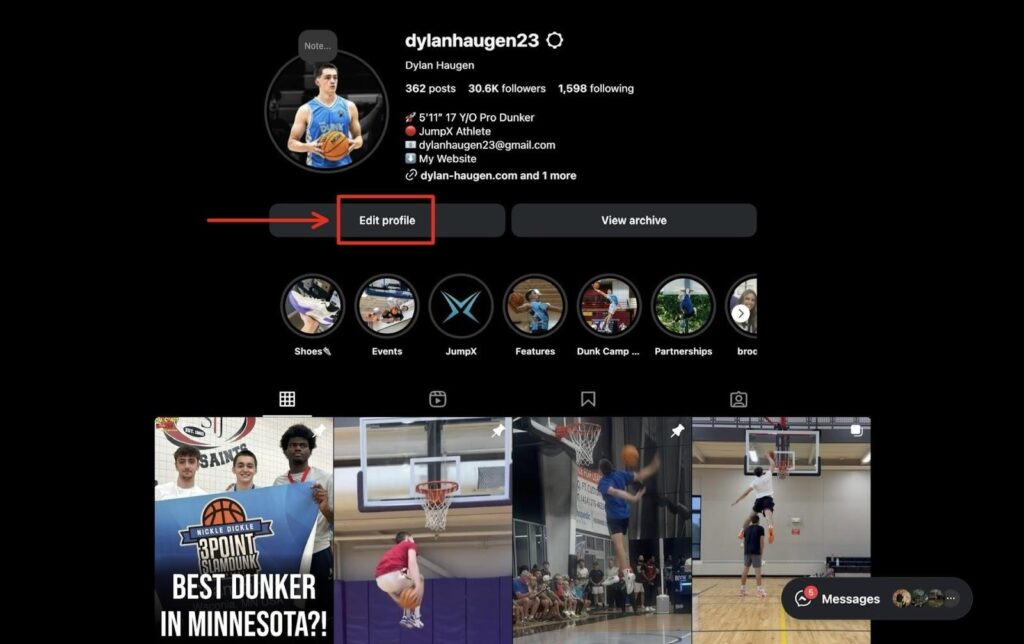
Instagram: Your profile while logged in showing Edit Profile.
Example for Instagram (similar for other social profiles)
X/Twitter: Account settings or profile while logged in.
TikTok: Profile while logged in (edit controls visible).
Facebook Page: Page Professional Dashboard or Page settings.
Screenshot tips
Capture the full browser window with the URL bar in view.
Include your user avatar/initial and any “Edit”/“Admin” indicators.
Don’t crop away the elements that prove access.
Suggestion: You’ll want to prioritize your strongest assets, but no matter what, aim to bring 5.
3) Claim Statement (We’ll polish this together)
Our team will generally provide the claim statement, which answers the question: “Tell us why you’re claiming this Knowledge Panel.” However, we can always adjust it if something doesn’t make sense or if you’d like to add additional context before submitting.
Template Example:
I am [Full Name], a [profession/field], best known as [primary title or project]. I’ve [achievement or milestone #1], and my work has been featured by [press or media name]. I collaborate with brands such as [brand list], and am part of [organization or group], contributing to [area of impact]. Having a verified Google Knowledge Panel supports my credibility, sponsorships, and visibility within [your industry/community].
This statement should reflect the areas where you have strong Experience, Expertise, Authority, Trust (EEAT):
Press mentions or interviews (news features, podcasts, articles)
Competition results or event listings
Brand partnership announcements or sponsor features
Bylined content or published materials
Coaching, organizational, or leadership roles
Media appearances or coverage
4) What We’ll Do on the Call
During our session, we’ll use our Knowledge Graph Explorer tool to locate the correct entity that best represents you — the one most filled with your content, media appearances, and other verified references across the web.
Once we’ve confirmed that entity, we’ll walk through all the claiming steps together, ensuring each field and submission detail aligns with Google’s verification standards.
After submitting your claim, Google typically responds within 24–48 hours, though they officially note it may take up to 72 hours to complete verification.
Common Reasons Claims Fail (avoid these)
Blurry or mirrored ID selfie; name mismatch with the form.
Missing signed-in screenshots (no proof of ownership).
Broken links or private profiles.
Claim statement is generic or makes unsupported claims.
Questions?
We’re very excited to help you get your Knowledge Panel claimed and verified. Having these items ready before our call will make the process much smoother and drastically speed things up.
Once again, please ensure you’ve gathered or prepared everything listed above so we can make the most of our time together. If anything is difficult to provide, just let us know before the call and we’ll suggest suitable alternatives.
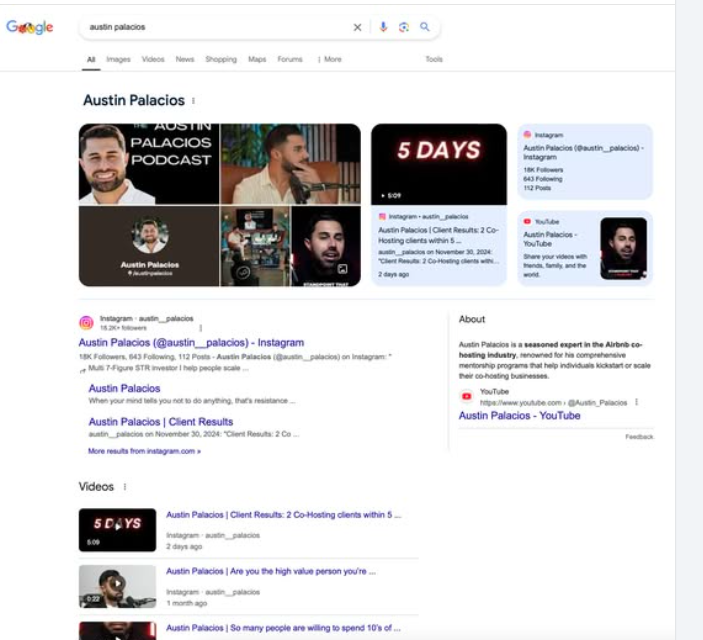
Want to build a strong online presence? Austin Palacios, a dynamic entrepreneur and real estate investor, reveals his formula for creating a powerful digital footprint.
By turning podcasts into YouTube videos, social media content, and even a book, Austin has not only provided valuable content but also earned himself a prominent Knowledge Panel on Google.
How does it work? First, Austin records insightful podcast interviews with top-level entrepreneurs, business leaders, and real estate investors on his podcast, The Austin Palacios Podcast. Next, he repurposes those episodes into shorter, shareable clips for platforms like YouTube, Instagram, and LinkedIn.
By doing so, he captures a broader audience and encourages engagement across multiple channels. Over time, these efforts help solidify his online reputation, build credibility, and increase visibility in search results.
By claiming and optimizing his Knowledge Panel, Austin ensured his most accurate and authoritative information appears when people search for him. This strategic move not only increases his credibility but also gives potential clients and partners a reliable, first-impression resource.
If you’re ready to establish authority, build trust, and make your mark online, start by repurposing your content like Austin—and watch your digital presence grow.
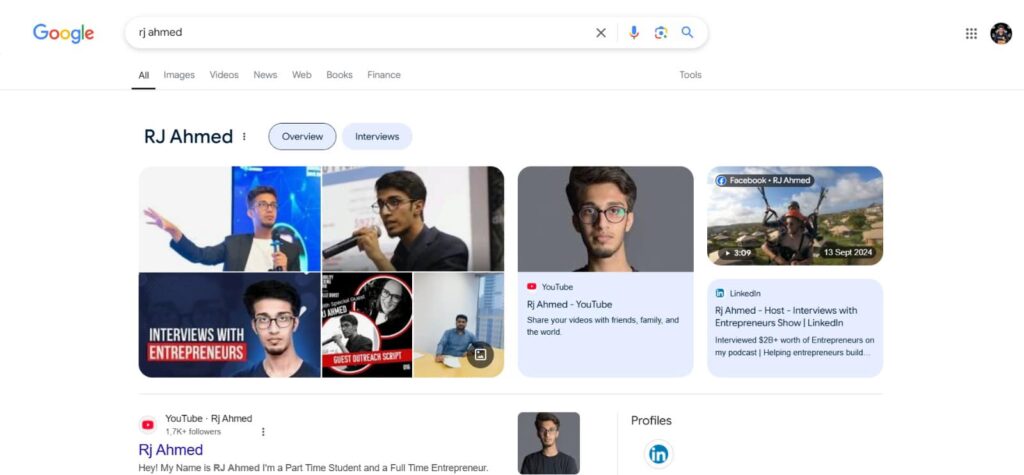
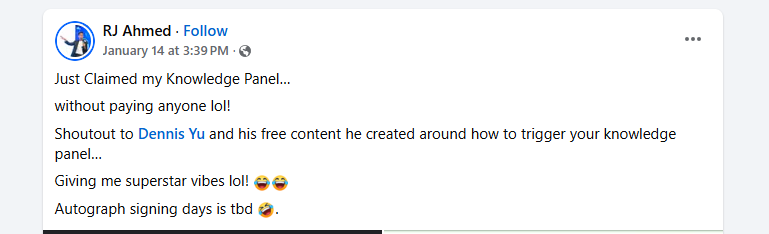
Did you know that getting a Google Knowledge Panel doesn’t have to cost a fortune or involve complicated tricks? RJ Ahmed recently proved just how straightforward it can be.
RJ Ahmed claimed his Knowledge Panel entirely on his own, using nothing but free content. “You can’t pay someone for a Google Knowledge Panel—even though many agencies will try to pretend you can,” he said. “When you have the right authority components, organize them, and then claim them, you get a Knowledge Panel. It’s as easy as that.”
In fact, by following Dennis free advice and resources, RJ was able to pull together the necessary authority signals and present them in a way that got Google’s attention. Instead of relying on paid services or gimmicks, he used the clear guidance and structured approach he have laid out—proving that when you follow the right process, you get real results.
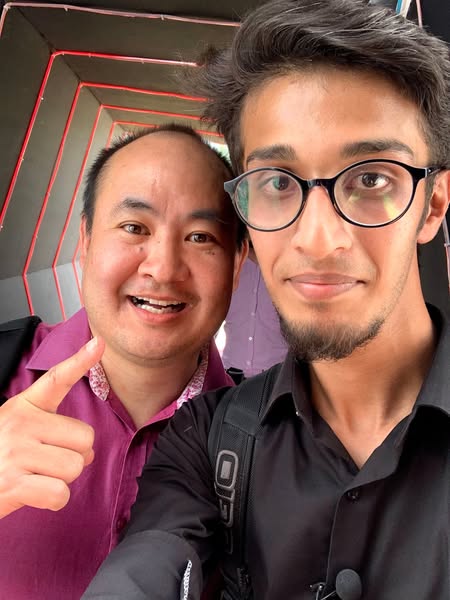
RJ Ahmed and Dennis Yu
Many entrepreneurs and creators have found that Dennis content provides practical, no-cost strategies to establish online authority. By focusing on building a solid online presence and organizing the right information, anyone can take the same steps RJ did, no expensive shortcuts required.
What if I told you a former bricklayer from London could show you how to network with some of the world’s biggest names? No gimmicks, no elaborate schemes—just a simple shift in mindset and a willingness to take action.
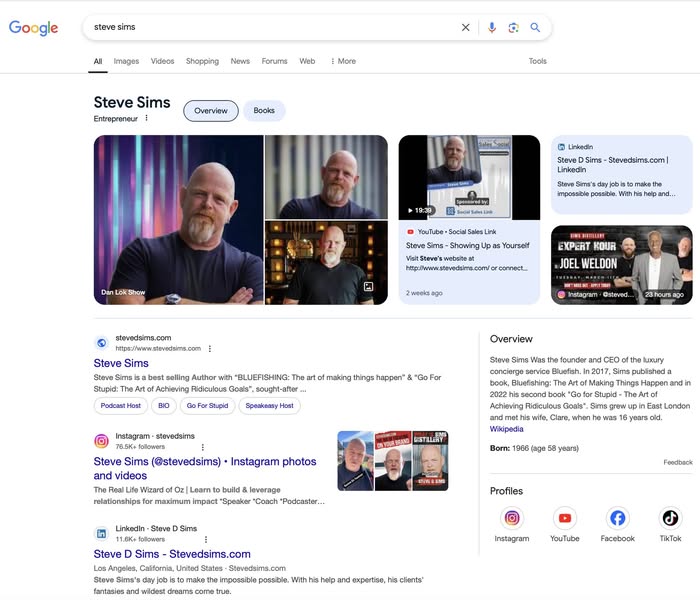
Steve Sims did exactly that, transforming a humble start into an extraordinary career mingling with Elon Musk, Richard Branson, Elton John, and many more. He’s not just in the room—he’s creating unforgettable experiences, writing bestselling books, speaking on renowned stages, and inspiring others to dream bigger.
When Dennis asked him how he managed to get such high-profile guests on his podcast, Steve’s answer was surprisingly straightforward: “Just ask.” No complicated strategies, no hidden formulas—just a willingness to reach out, form connections, and offer value.
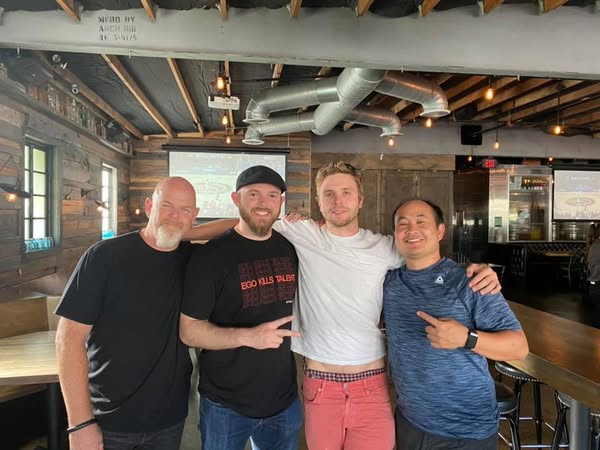
Dennis Yu, Steve Sims, and Henry Sims
But that’s not all that sets Steve apart. He understands the importance of branding—not just in the traditional sense, but in owning a digital footprint that reflects his real-world impact.
He’s secured a full Google Knowledge Panel, connecting his social channels and content so that anyone searching his name gets the full picture. It’s a signal of authority, credibility, and visibility that amplifies everything he’s accomplished.
Even while battling cancer, Steve hasn’t slowed down. Instead of retreating, he’s doubled his efforts to help other entrepreneurs succeed. While most people might crumble under the weight of such challenges, Steve reframed his approach.
He turned from working harder to thinking smarter, from being the asset to owning assets—investments, businesses, relationships, and opportunities. His story is a masterclass in creating value and leveraging connections.
So, if you’re ready to step up and own your own piece of the digital landscape, now’s the time to start. Whether it’s reaching out to someone who inspires you or solidifying your online presence, the path to building a powerful personal brand is right in front of you.
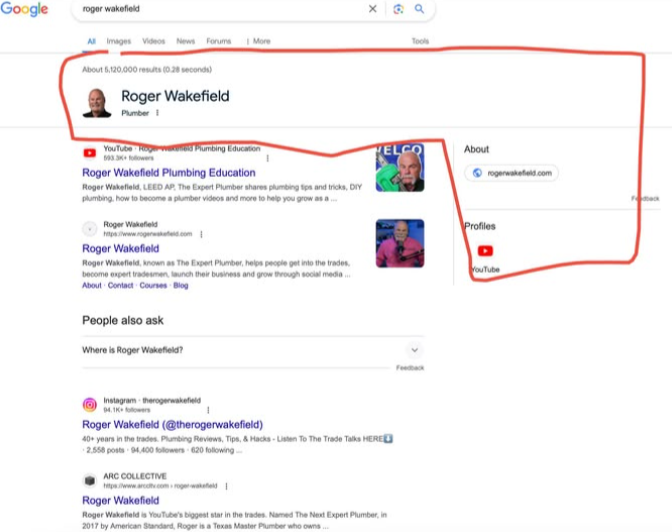
Roger Wakefield, a plumber turned digital influencer, is proof that a strong personal brand can catapult you to the top of search results.
Through strategic content creation, consistent audience engagement, and a clear focus on his niche, he achieved a coveted Google Knowledge Panel—an achievement that sets him apart from countless service professionals.
Roger’s digital journey began with a focus on authenticity and expertise. While many businesses see LinkedIn or their main website as their top search result,
Roger’s YouTube channel took the lead. By producing helpful, relatable content that addressed his audience’s questions and needs, he established himself as an industry authority. His videos not only ranked highly on YouTube but also boosted his credibility across search engines.
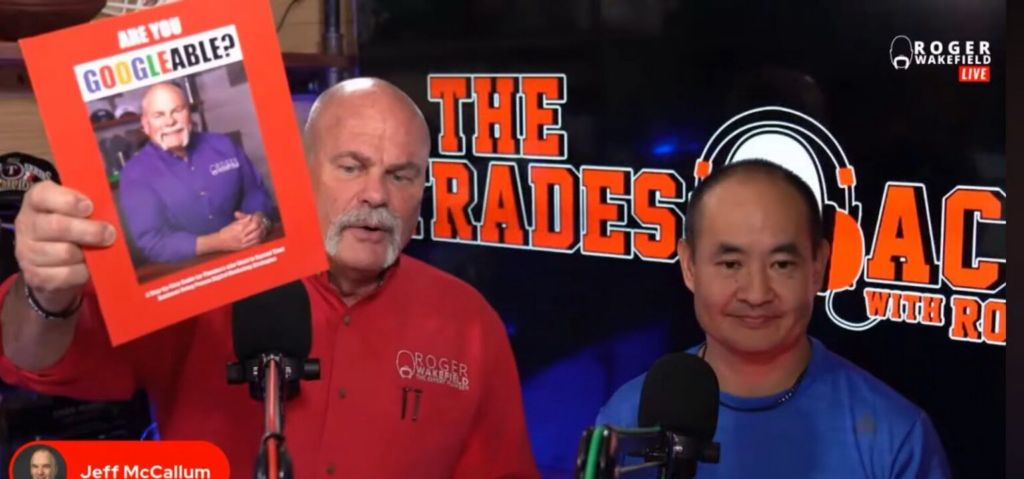
The release of Dennis book, Are You Googleable?, with Roger Wakefield, served as a cornerstone for his digital strategy.
Roger Wakefield is showcasing his book, Are You Googleable?
This book tied together his content, messaging, and social presence, helping him solidify his Knowledge Panel and amplify his reach. With every new piece of content, from videos to blog posts, Roger reinforced his position as the go-to expert in his field. His Knowledge Panel expanded to include his social media profiles, further demonstrating his credibility.
Roger’s success also showcases the power of strategic, targeted advertising. By running low-cost, highly-focused Dollar-A-Day ad campaigns, he maintained engagement across multiple channels.
These campaigns signaled to Google that his audience remained active and interested, helping sustain his top search ranking. Every video, blog, and ad contributed to the broader ecosystem of his personal brand, ensuring that when people searched for plumbing advice, his name appeared first.
But Roger’s rise isn’t just about technical SEO or marketing tactics. It’s a testament to the value of relationships, authenticity, and consistent effort.
He didn’t rely on gimmicks or shortcuts. Instead, he built a reputation on genuine expertise and real results, showing others in the service industry what’s possible when you invest in your personal brand.
For professionals in any field, Roger’s story is a powerful reminder. Establish your authority by sharing real, valuable knowledge. Keep your audience engaged through honest, helpful content.
Collaborate with experts like Dennis Yu to refine your strategy. Over time, these steps can lead to the same outcome Roger achieved, an expanded Google Knowledge Panel, greater visibility, and a thriving digital presence.
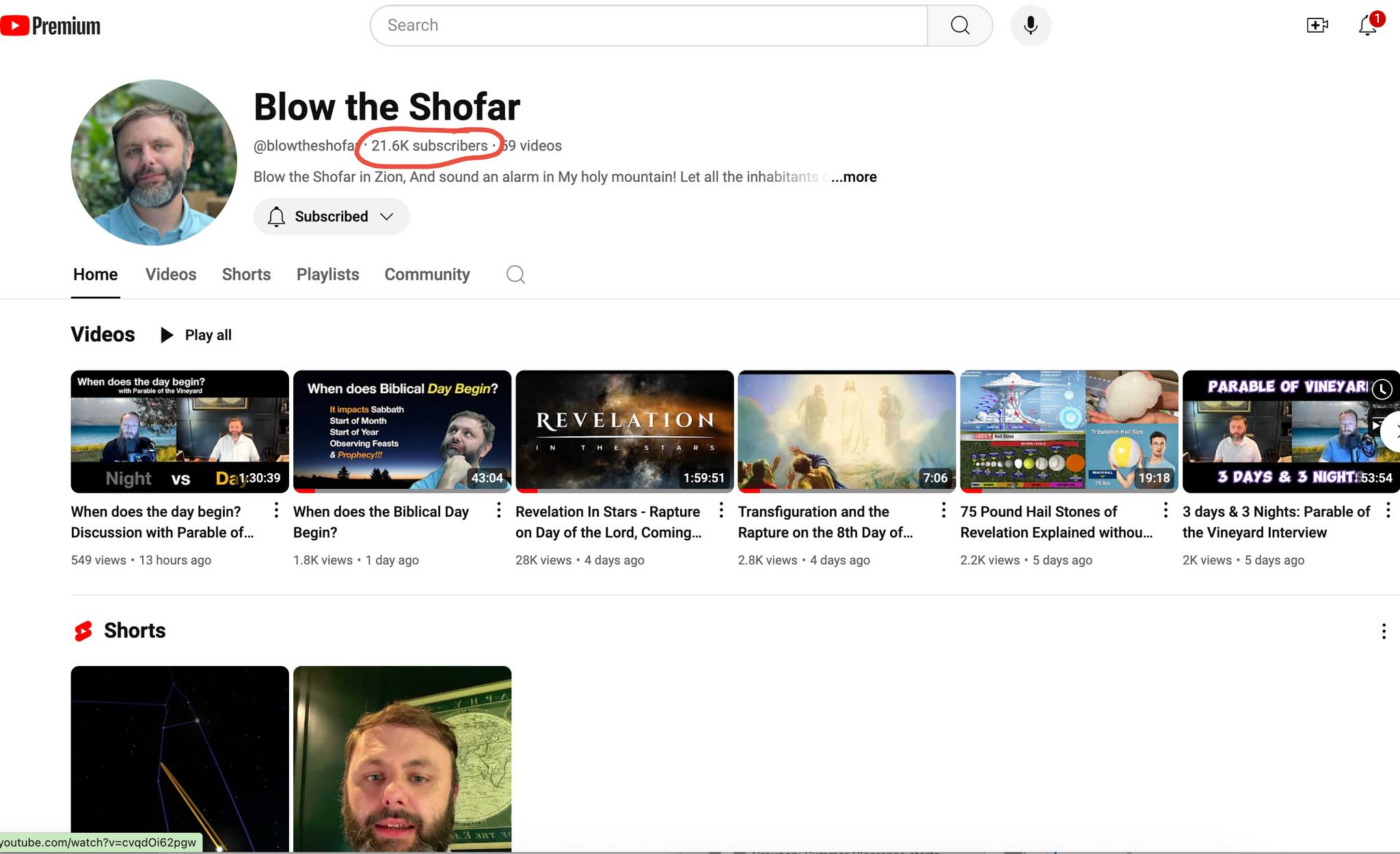
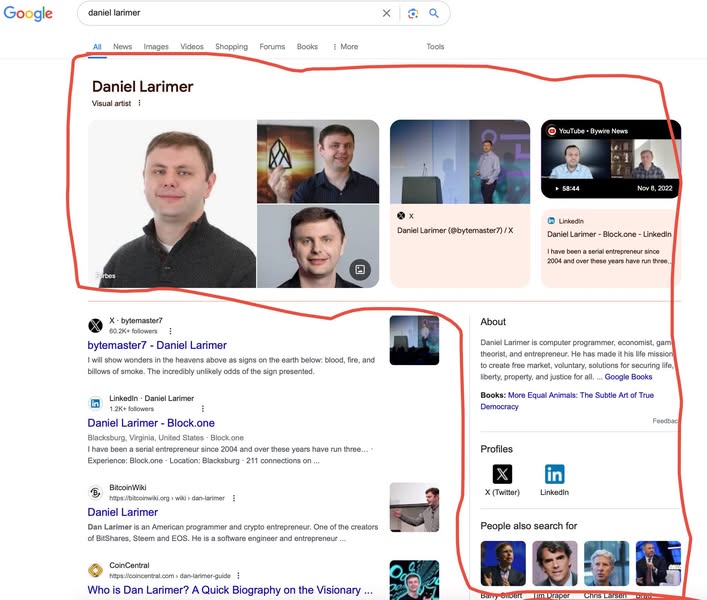
What does it take to make yourself truly “Googleable”? As a watchman committed to unpacking biblical prophecy, Daniel Larimer doesn’t sell a product or chase recognition.
Instead, he puts all his energy into carefully researched, scripturally grounded videos on his YouTube channel, Blow the Shofar. And the result? More people than ever are not only learning from his teachings but also wanting to know who he is.
When people search for Daniel, they’re met with a well-structured knowledge panel, clear information, and content that leads them to his mission-driven message. This isn’t about vanity; it’s about ensuring his message reaches those seeking understanding.
With 20,000 subscribers today, and growing fast, Daniel’s approach demonstrates the power of connecting meaningful content with smart digital strategy. By building a personal brand website, leveraging Google’s knowledge graph, and using targeted ad campaigns on platforms like YouTube,
Daniel has expanded his reach significantly. In just three weeks, his channel jumped from 3,000 to 20,000 subscribers, and it’s all fueled by the content people want: videos that hold their attention for nearly 25 minutes at a time.
Daniel’s focus on quality content and audience engagement, paired with a data-driven ad strategy, is paying off.
His work shows that when your message resonates and you back it up with the right strategy, you don’t just gain viewers, you earn trust, authority, and a prominent spot in the digital landscape.
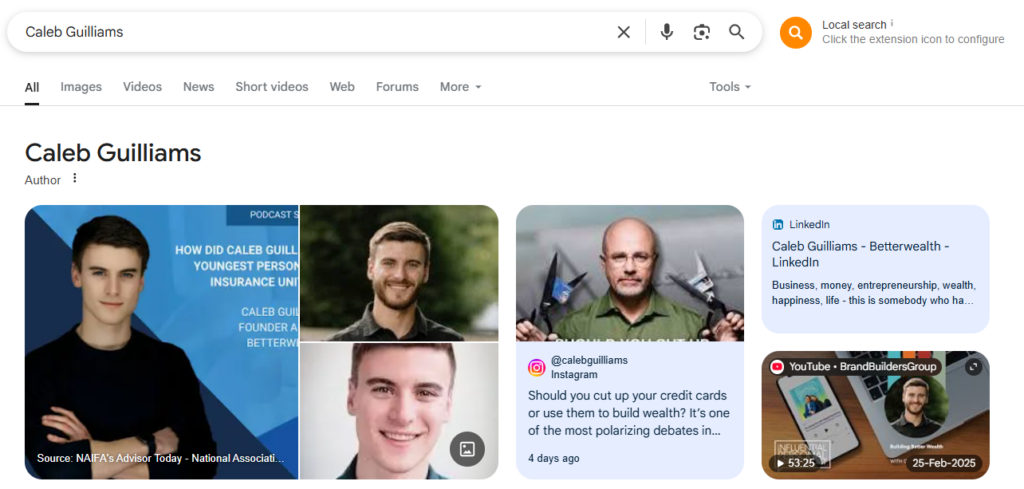
Caleb Guilliams’ journey from minimal online presence to a prominent Knowledge Panel exemplifies how strategic digital efforts directly increase this score, solidifying his digital authority.
Caleb Guilliam’s Knowledge Panel
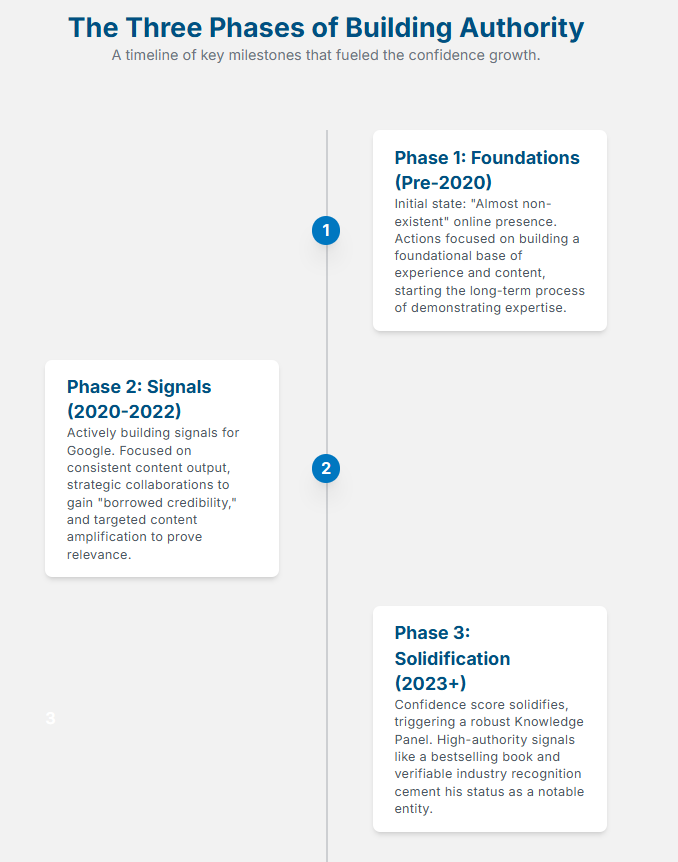
Phase 1: Laying Foundations (Pre-2020)
Caleb Guilliams’ path into the financial sector began at an exceptionally young age, driven by a profound fascination with wealth creation and management.
As a teenager, he demonstrated remarkable initiative by immersing himself in financial literature, notably reading influential texts such as “Richest Man in Babylon” and “Good to Great”.
This early intellectual curiosity and self-education laid the foundational “Experience” and “Expertise” that would define his career.
His professional ascent was notably rapid and hands-on. By the age of 19, while still in college, he had already advanced from a bank teller position to taking over the entire investment division at a local community bank.
This direct, early experience in a significant financial role provided him with invaluable practical knowledge and a unique perspective on traditional financial advising. Committed to identifying and implementing more efficient wealth-building strategies for his clients, he embarked on an extensive two-year period of travel across the country, actively seeking mentorship and knowledge from leading financial experts.
This dedicated pursuit of advanced financial principles further deepened his “Expertise” and “Experience.”
This intensive period culminated in the founding of BetterWealth Solutions in 2017, when he was just 21 years old. The establishment of BetterWealth served as his foundational business entity, which would later become the central hub for his burgeoning online presence.
During this initial period, Caleb Guilliams’ online presence was described as “almost non-existent” or “almost no social presence online”. This indicated a very low initial Google Confidence Score for his personal entity.
However, he initiated a crucial component of his future authority: the “BetterWealth Podcast with Caleb Guilliams.” While the precise launch date of the podcast’s earliest episode is not explicitly detailed, its active status is evidenced by reviews dating back to July 2020, indicating that consistent content production was already underway by that time.
This pre-emptive accumulation of high-quality content, rooted in his direct experience, provided the essential raw material that would later be leveraged for broader amplification and the eventual triggering of his Google Knowledge Panel.
Phase 2: Building Signals – Growing Confidence (2020-2022)
This period marks a pivotal shift for Caleb Guilliams, characterized by the active implementation of structured digital marketing methodologies, particularly those championed by Dennis Yu and BlitzMetrics. These frameworks are designed to systematically cultivate online authority and facilitate the emergence of Google Knowledge Panels by boosting the Confidence Score.
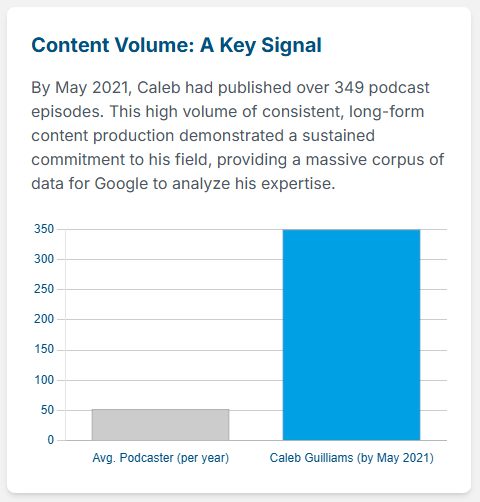
Consistent content production remained a cornerstone of Caleb’s strategy, directly showcasing his “Expertise” and “Experience.” The “BetterWealth Podcast” continued to operate as a primary content engine. By May 2021, episode 349 had been published, signifying a high volume of consistent output.
This aligns perfectly with the Content Factory model, which transforms long-form audio and video into numerous smaller, digestible assets. Furthermore, Caleb’s blog on BetterWealth.com served as a central repository for this repurposed content, further signaling his expertise and ongoing activity to Google.
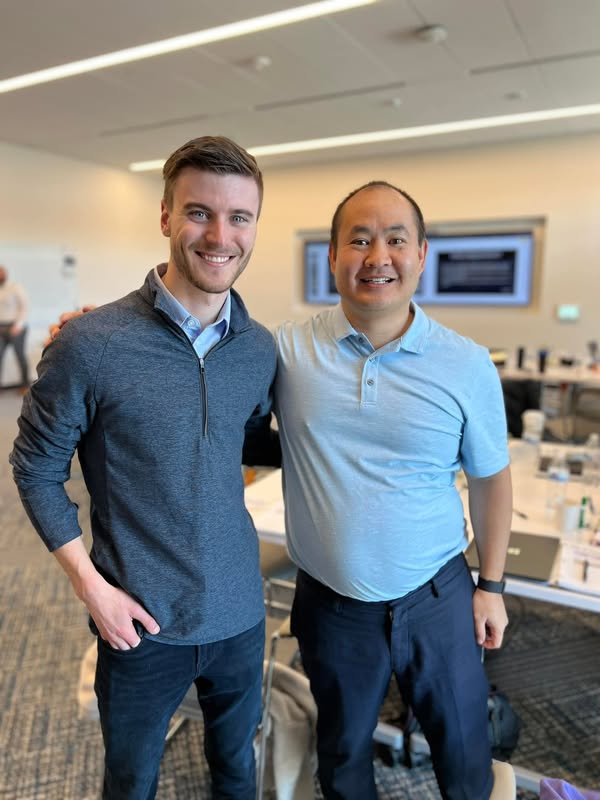
Dennis Yu and Caleb Guilliams
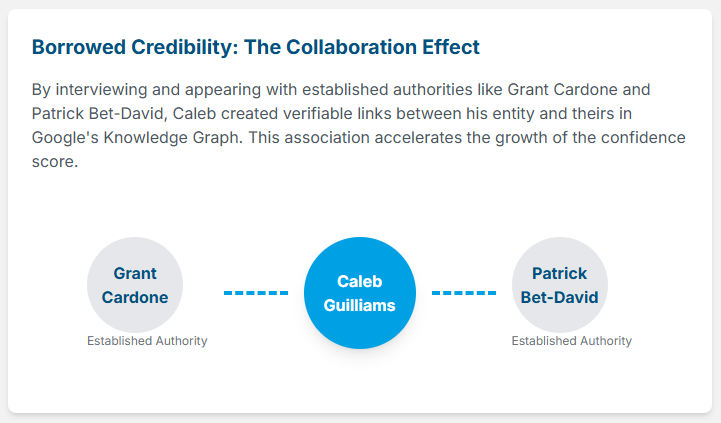
A significant accelerator during this phase was Caleb’s engagement in strategic collaborations, a tactic often referred to as “borrowed credibility.” He actively participated as a guest on various podcasts, including “The Kim Barrett Show Podcast” in November 2022.
More importantly, he conducted interviews with highly recognized figures in the business and finance world, such as Grant Cardone, and appeared on prominent platforms like Patrick Bet-David’s “Valuetainment” podcast.
These interactions were not merely networking opportunities; they represented a deliberate strategy to associate his emerging brand with established authorities. When a less-known entity is consistently linked with highly authoritative and notable figures, Google’s Knowledge Graph begins to draw connections and implicitly transfer a degree of that established authority, significantly accelerating the recognition process and providing a potent signal that Google values highly for its E-E-A-T guidelines.
The “Dollar-a-Day Ads” strategy was employed for content amplification, reaching targeted audiences with minimal budget. This generated crucial engagement signals, further contributing to Google’s confidence in his relevance and authority.
The period spanning from 2023 onwards marks the tangible manifestation of Caleb Guilliams’ strategic efforts, culminating in the prominent display of his Google Knowledge Panel.
While an exact initial appearance date is not precisely documented, articles by Dennis Yu published in March 2024 and January/May 2025 explicitly showcase “Caleb Guilliam’s beautiful Knowledge Panel”.
This confirms that by at least early 2024, his Knowledge Panel was not only established but also robust and comprehensive. The transition from having “almost no social presence” to possessing a Knowledge Panel and ranking “near the top life insurance inquiries internationally” represents a direct manifestation of his significantly increased Google Confidence Score.
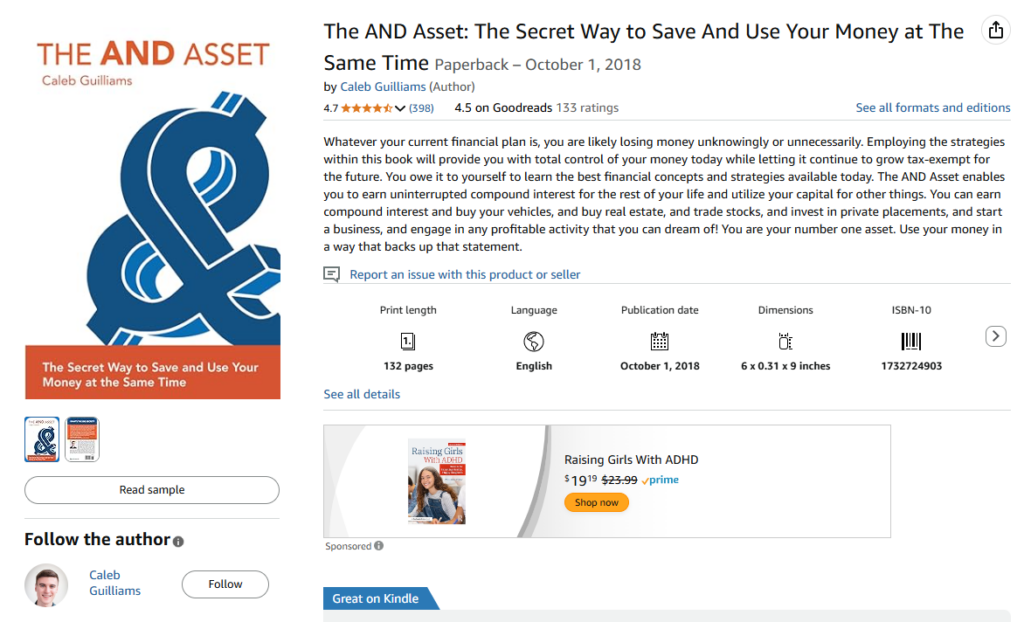
Caleb Guilliam’s book listing on Amazon
A significant milestone directly impacting this emergence and solidifying his “Authority” was the widespread recognition of his book, “The AND Asset.”
While initially copyrighted and published by BetterWealth Publishing in 2018 (as a second print edition in October 2018), a Kindle edition was subsequently published on April 17, 2023.
This later digital publication and continued promotion likely contributed to its “bestselling book” status and renewed visibility.
A published book, particularly one that attains bestseller recognition, serves as an exceptionally strong and verifiable signal of expertise and authority. It provides a tangible, easily identifiable asset that Google can directly link to an individual, thereby significantly bolstering the “Authority” component of the E-E-A-T framework.
Dennis Yu explicitly notes that “repurposing episodes into a book helps even more” in the context of Knowledge Panel development.
Beyond the book, Caleb’s strategy involved continuous amplification and entity stacking, further demonstrating his ongoing “Experience” and “Expertise.” His consistent output of content on BetterWealth.com, including frequent blog posts and videos, continues to feed the Knowledge Graph with fresh, relevant information. This includes a wide array of topics such as:
Life Insurance Expertise: “Understanding Front-Loading with Whole Life Insurance,” “Is Whole Life Insurance Worth It in 2025? (Pros and Cons),” “How to Use Infinite Banking to Invest in Real Estate in 2024,” “Why Are Banks Buying Life Insurance Policies,” “When Should You Take a Loan from Your Life Insurance Policy,” and “Are There Tax-Free Savings in Life Insurance”. His company, BetterWealth, specializes in customized life insurance plans and overfunded whole life policies. He is widely known as the “life insurance guy”.
Tax Strategy & Planning: “Burying Bodies = Secret Tax Loophole?”, “Biden Raises Taxes on the Middle Class the New Tax 1099-k Explained,” and “How the Rich Use Charities to Pay ZERO Capital Gains Tax”. BetterWealth offers comprehensive tax strategy, planning, filing, bookkeeping, and fractional CFO services.
Investment & Wealth Management: “Are Life Settlements a Good Investment,” “Are Rare Earth Metals a Good Investment,” “Why Retirement Is a Scam,” “What Is the Difference Between an Asset and A Liability,” and “Why Average Rate of Returns Are So Misleading”. BetterWealth provides investment management and retirement planning services.
Entrepreneurial & Personal Finance Coaching: “Become the Most Valuable Version of Yourself NAIFA Apex Keynote,” “Are You Dumb for Using Credit Cards,” “Are Restaurants Keeping You Broke,” and “The Secret to an Unstoppable Entrepreneurial Mindset”. BetterWealth offers personalized coaching and helps entrepreneurs gain control over their finances.
The ongoing application of “Dollar-a-Day Ads” for content amplification has proven highly effective.
For instance, targeting members of NAIFA (National Association of Insurance and Financial Advisors) with Caleb’s content yielded an “insanely good” 18% click rate. This demonstrates not only effective audience reach but also a high degree of relevance and resonance, which Google interprets as strong signals of authority and engagement.
Furthermore, his recognition within professional circles, being widely known as the “life insurance guy” and his association with NAIFA, provides robust real-world authority signals that Google can verify. His company, BetterWealth, serves clients in 50 states and has produced 1263 educational videos, showcasing extensive reach and educational output.
Testimonials from clients, such as Jess Morey, a Cyber Security Professional, highlight the “detailed” education and “quality life insurance education at its finest” provided by BetterWealth, further building “Trust”.
The continuous nature of these efforts underscores a critical understanding: Google’s Knowledge Graph is dynamic. It does not merely recognize an entity once and then cease evaluation. Instead, it continuously assesses and updates its understanding based on new, consistent, and authoritative signals.
Sustained engagement through ongoing content creation, strategic collaborations, and targeted promotion reinforces the initial signals, leading to a more stable, comprehensive, and competitive Knowledge Panel. The perceived “Confidence Score” is not static; it necessitates continuous effort in “seeding the information layer” with verifiable data to maintain and enhance its robustness in search results.
The following table summarizes Caleb Guilliams’ key online milestones and their impact on his journey to Knowledge Panel authority and increasing Google Confidence Score:
Table 1: Caleb Guilliams’ Key Online Milestones & Impact on Google Confidence Score
Date/Period
Milestone/Event
Impact on Google Confidence Score & Knowledge Panel
Pre-2020
Minimal online presence; Founded BetterWealth (2017)
Initial Low Confidence Score: Baseline established; foundational business entity created. Early self-education and practical experience in banking.
~2018-2020
Launched BetterWealth Podcast
Beginning to Build Signals: Initiated consistent content generation, providing early data for Google’s understanding of his expertise.
2020-2022
High-volume podcasting (e.g., Episode 349 by May 2021)
Growing Confidence Score: Demonstrated sustained expertise and content volume, feeding the Knowledge Graph with verifiable information.
2020-2022
Strategic collaborations (Grant Cardone, Patrick Bet-David, Kim Barrett Show Nov 2022)
Accelerated Confidence Growth: Gained “borrowed credibility” from established authorities, signaling increased notability and expanding his network.
2020-2022
Consistent application of “Content Factory” & “Dollar-a-Day Ads”
Enhanced Confidence Signals: Amplified content visibility and engagement, directly contributing to Google’s understanding of his relevance and authority.
April 17, 2023
Published the Kindle Edition of “The AND Asset” book (bestselling). Previously published as a paperback in 2018.
Significant Confidence Boost & Trigger: Provided a definitive, high-authority signal, a key factor in Knowledge Panel emergence and solidifying his expertise.
Early 2024 – Present
Google Knowledge Panel confirmed & robust
Solidified Knowledge Panel & High Confidence: Tangible outcome of accumulated authority, ranking “near the top life insurance inquiries internationally”.1
Ongoing
Continued content, amplification, and industry recognition (NAIFA, 50 states served, 1263 videos)
Sustained High Confidence: Continuous reinforcement of E-E-A-T, maintaining and enhancing Knowledge Panel prominence through ongoing, verifiable contributions.
Want a Knowledge Panel Like Caleb’s?
Caleb Guilliams didn’t get a Knowledge Panel because he was famous—he earned it by consistently sharing real expertise, collaborating with high-authority voices, and amplifying content that proves he’s the real deal. His bestselling book, high-volume podcast, and laser-focused authority signals helped Google confidently recognize him.
If you’re a financial expert, founder, or coach who wants that same level of verified authority, we’ll help you build it.
Check out our Done-for-You Knowledge Panel Package. We’ll apply the same proven strategies—entity building, E-E-A-T content, smart collaborations, and structured amplification—to make Google recognize you as the authority in your niche.
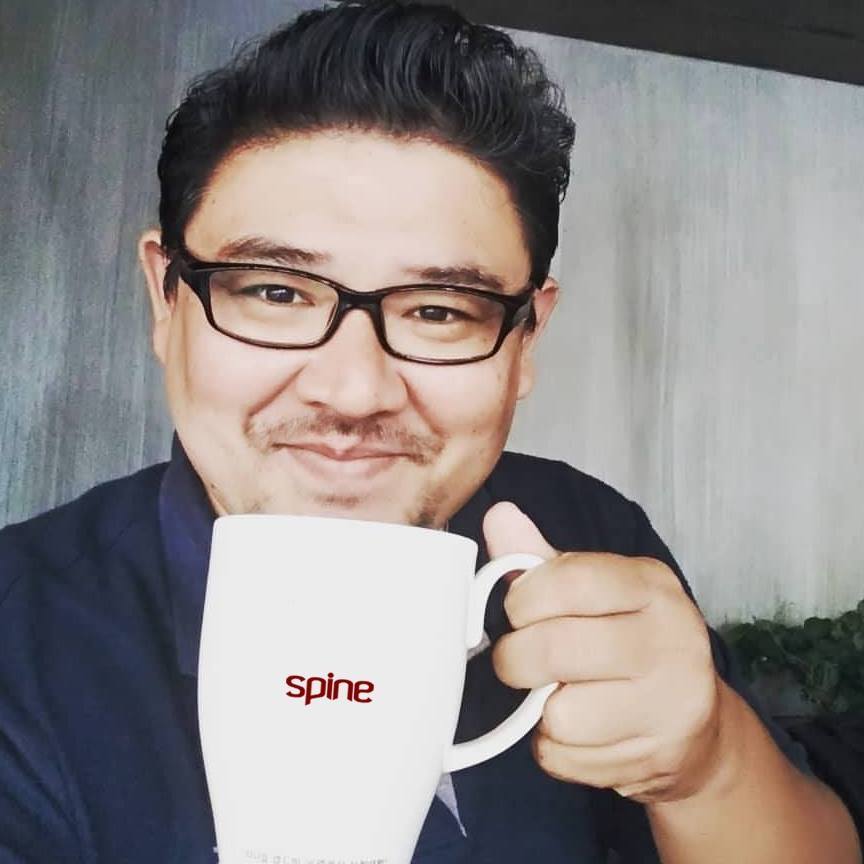
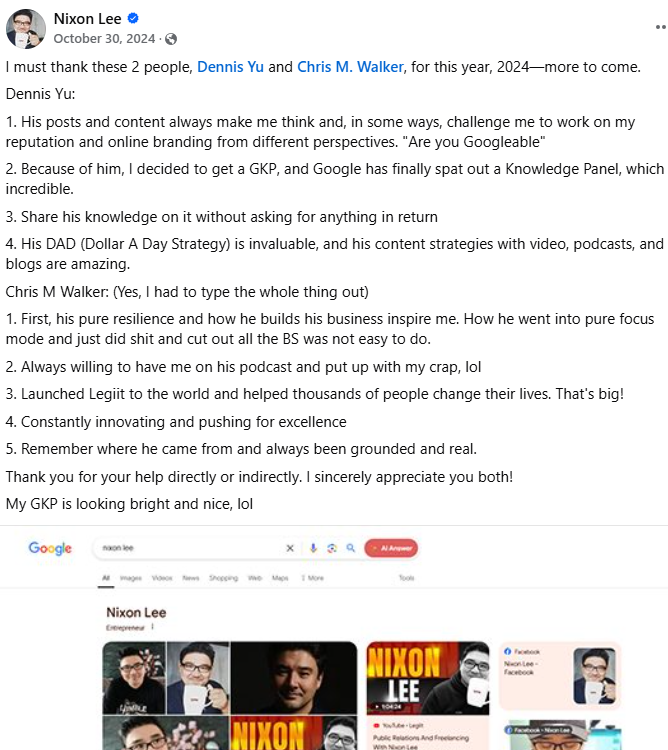
Nixon Lee, founder of Malaysia’s fast-growing content distribution company Spine PR, is redefining what it means to build an online reputation. Starting from scratch, Nixon turned an initial concept into a thriving seven-figure business, all while carefully honing his personal brand. This year, he reached an exciting milestone: claiming his Google Knowledge Panel.
Guided by the influence of industry thought leaders like Dennis Yu and Chris M. Walker, Nixon took steps to secure his brand’s digital identity before someone else could. The Knowledge Panel not only makes him more “Googleable,” but also cements his credibility in an increasingly crowded market.
With a clearer online presence, Nixon now stands out as a trusted voice in content strategy and PR.
The process wasn’t easy. It required dedication, strategic thinking, and the resilience Nixon is known for. His efforts to acquire a Knowledge Panel demonstrate how today’s entrepreneurs can leverage the right tools and strategies to elevate their personal branding, leaving a lasting impression in their industry.