In this video, Jack and Dennis discuss how young adults can help fix the digital marketing for their parents’ businesses. They share practical insights into advertising, content creation, and SEO fundamentals.
If you’re a young adult looking to build real marketing skills and serve local businesses, check out the High Rise Academy program to get hands-on training and mentorship.
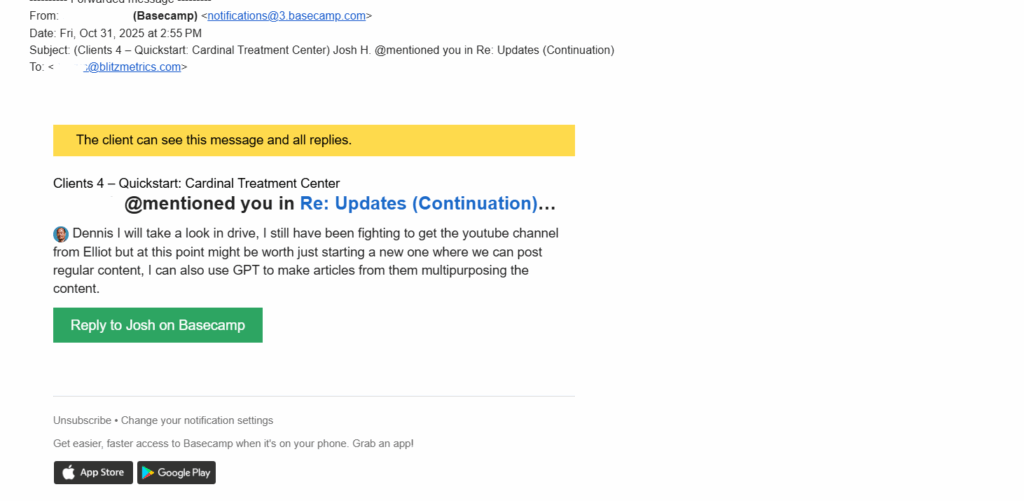
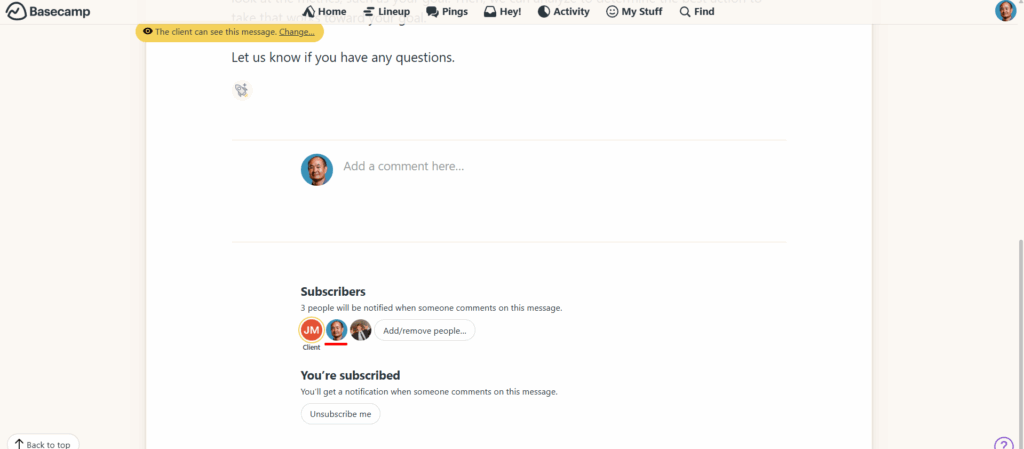
Every time someone tags me in Basecamp, I get two emails for the same message: one for the post, and one for the mention.
Multiply that by dozens of projects, and you’ve just doubled the noise in an inbox that already gets over a thousand emails a day.
I manage 1,000 emails a day. Every unnecessary ping pulls me away from the high-value work that keeps everything moving: strategy, client relationships, training, and developing the next generation of digital leaders.
Tagging me in Basecamp might seem like a quick way to get my attention, but it actually creates friction.
It breaks the system we built to keep communication smooth, focused, and accountable.
A = Accountable (the person ensuring it gets done).
C = Consulted (people giving input).
I = Informed (people who just need to know).
When you tag someone just to make sure they “saw it,” you’re bypassing that structure.
It’s like cutting across traffic because you don’t feel like waiting for the light; it might save a second, but it causes chaos.
We Built Systems for a Reason
We created the Level 1 Guide to make this process easy for new folks and anyone who hasn’t worked in a high-functioning team before. It’s all spelled out, who does what, where updates go, and how to communicate clearly without creating extra noise.
Following these systems is about protecting focus. Every time you skip the system, you create work for someone else and that ripple effect slows everyone down.
Tag the Project Not Dennis — Here Is the Basecamp Rule
Don’t tag me in Basecamp. If I need to be looped in, assign the task to the right person and let the process work. If it’s truly urgent, use the proper channels.
We win by running clean systems, not by shouting louder in the digital hallway.
High Rise Academy is designed for people who take action. Success comes from following the Metrics → Analysis → Action (MAA) process every week. Apprentices who do the work, communicate clearly, and follow through on assignments build measurable results and real skills.
Dennis Yu emphasized during the conversation that the Academy only works for those willing to “do the thing.” As he explained, people who collect metrics but never implement improvements are “getting paid to do nothing.”
The Foundation: Taking Consistent Action
Many projects fail because people spend too much time reporting and not enough time executing. Every week should include progress—new videos published, ads launched, or landing pages improved.
Our process relies on three steps:
Metrics: Track specific numbers tied to your work, such as video performance metrics or ad performance.
Analysis: Identify what changed and why.
Action: Implement the next improvement before the next report.
Jack Wendt mentioned how some participants kept producing the same weekly reports without changing a thing. He shared that those projects “looked busy on paper but delivered no new client results.” This reinforced the Academy’s focus on action, not appearance.
Dylan Haugen added that every weekly status report feeds the coaching process. “The more action they take,” he said, “the more feedback we can provide.” When students actually produce videos, launch ads, or adjust campaigns, coaches have data to work with and can give sharper guidance.
Communicating Effectively
Remote work depends on timely, organized communication. Team members are encouraged to apply the Do / Delegate / Delete framework:
Do the next task from your checklist.
Delegate when you hit a roadblock and need support.
Delete low-value items that don’t advance the goal.
Jack recalled several examples where simple communication lapses caused unnecessary delays—someone waited days to ask a question instead of flagging it early. “If they’d just said something, we could’ve solved it in five minutes,” he said. Clear updates keep everyone aligned and prevent small issues from slowing progress.
Skills that Support Success
Participants who think clearly, express ideas in writing, and approach problems logically tend to perform well. The program rewards those who take ownership of their work, stay organized, and use available tools to keep improving.
Dennis highlighted that being able to reason through tasks with AI tools or team members is key to growth. “Young adults who can talk through a problem and provide context always do well,” he said. This ability to explain intent and process mirrors how top performers handle real client projects.
Follow-Through Makes the Difference
Age and credentials matter less than reliability. Students as young as fourteen have produced outstanding results through consistent follow-through.
Dennis shared one story about a 14-year-old student who completed every assignment on time, produced content weekly, and analyzed results without prompting. That consistency led to measurable growth and personal confidence. In contrast, he mentioned older participants who “have to ask a question every single time” or constantly make excuses—and they rarely advance.
To stay on track:
Dedicate at least one hour per day to assignments.
Complete and submit a weekly status report summarizing what you shipped, what you learned, and what comes next.
Plan around vacations or other priorities so deadlines are met.
The goal is steady progress, not perfection.
What Success Looks Like Week to Week
Each week, successful participants:
Publish new work such as a video, ad, or content update.
Record clear performance metrics and note what improved.
Decide on the next concrete action to take.
Review targeted feedback from mentors and apply it immediately.
Dylan described one student who launched a short-form video campaign and then tracked its performance in the weekly report. “They took the feedback, adjusted the titles and tags, and doubled their watch time in a week,” he said. That’s the type of learning loop the program aims to build.
This cycle—action, reflection, improvement—builds measurable skill and momentum.
How to Prepare and Self-Assess
Identify specific actions you can take this week.
Choose one checklist and complete the first task today.
Start your weekly status report document now and update it as you complete work.
Reserve your hour-a-day block on your calendar for the next two weeks.
These steps help you form the habits that lead to success inside the program.
High Rise Academy Works Only for Those Willing to Do the Work
High Rise Academy rewards people who act consistently, communicate clearly, and keep improving. Those habits matter more than background or prior experience. The more you build, measure, and refine, the more meaningful results you’ll achieve.
Dennis concluded the discussion by reminding parents and students that this program requires genuine interest. “We’re not here to babysit,” he said. “If they have that drive—whether it’s basketball, content creation, or entrepreneurship—they’ll thrive. If they don’t, they’ll struggle.”
Featured Image: Henry on a video call sharing his first week in High Rise Academy (placeholder)
When Dylan and I started High Rise Academy, our goal was simple: give young adults the tools, mentorship, and confidence to do real work for real businesses. Henry is one of the first apprentices to join, and his journey shows exactly how this program works in practice.
This story comes from a Youtube interview we did with Henry, reflecting on his early months in the program. What he shared provides a clear picture of what new apprentices can expect.
Flexibility From Day One
When we asked Henry what he loved most about the program, his answer was immediate: freedom and versatility.
He explained: “I can basically work from wherever I want as long as I have internet access and Wi-Fi.”
That flexibility meant Henry could work from his family’s cabin or his home without missing deadlines. For him, work-life balance wasn’t theory — it was lived experience.
This is the same principle Dennis Yu, Dylan, and I experienced when we spent a month traveling to eight countries and five U.S. states while speaking at conferences. Our output didn’t dip, because we follow documented processes like the Content Factory model.
Starting With No Experience
Henry admitted he had “little to no experience” before joining. His only teamwork experience came from school projects.
Within weeks, he built professional habits:
Communicating directly with clients.
Finishing projects on time.
Following through on commitments.
As Henry put it: “It’s greatly helped me to communicate with others, get work done on time, and finish what you said you would finish.”
Henry proves that even with no experience, the system works.
Building Transferable Skills
Henry quickly realized that the methods we used for a dentist could apply to almost any local service business — landscapers, plumbers, roofers, and more.
He learned to:
Build repeatable workflows for repurposing.
Adapt formats to each platform’s audience.
Use tools like Descript and Underlord to speed up editing.
Henry discovered that while tools help, real skill lies in understanding client goals and target audiences. That’s why we built documented processes like the Content Factory model: they create scalable systems anyone can learn and apply.
Weekly Reports and SEO Growth
Every Friday, Henry contributed to our MAA End-of-Week Reports. In week one, the reports simply listed content produced.
As weeks progressed, Henry learned how to:
Add SEO tracking.
Summarize keyword performance.
Include engagement numbers from social posts.
These reports became the backbone of client communication. Henry moved from never having written a report to producing one that guided business decisions. To see exactly how to structure these reports, check out our full guide on how to write Weekly MAA reports for local service businesses.
Support From the Team
Henry didn’t navigate this alone. He had access to mentors like Dennis Yu, Dylan, and myself, along with a full library of playbooks and processes.
As he explained: “Everything is documented. Everything that Dennis and BlitzMetricshas done is out there. You can literally just search whatever you’re saying.”
When apprentices run into obstacles, they’re never stuck. They can:
Reference documented checklists.
Ask team members who’ve executed these tasks thousands of times.
Henry is clear about the time investment. He doesn’t log hours for the sake of it. He focuses on getting projects done.
For apprentices managing one client, Henry estimated “probably no more than an hour a day” is sufficient. That makes High Rise Academy accessible for students, part-time workers, and young adults balancing other commitments.
Advice to Future Apprentices
When we asked Henry what advice he’d give someone just starting, he said: “At the beginning, I didn’t really know much. But there are so many resources. And even if you end up getting stuck, there are team members who’ve done this thousands of times you can fall back on.”
That mindset is exactly what makes High Rise Academy work: you don’t need to start as an expert. You need to start willing to learn.
Closing Thoughts
Henry’s journey represents what High Rise Academy is about: taking motivated young adults, giving them real-world work with real clients, and surrounding them with mentorship and repeatable processes that lead to success.
Key takeaways from Henry’s story:
Flexibility to work from anywhere.
Transferable skills that apply to any local business.
Step-by-step guidance through reporting, SEO, and content creation.
Supportive mentors and documented playbooks.
Realistic time commitment that fits into everyday life.
Want to build these skills while helping real businesses? Start by applying what Henry did — commit to doing the work, ask questions, and follow the process.
This expanded guide builds on our overview of the High Rise Influences AI Apprenticeship Program, or High Rise Academy, giving you deeper insight into how we help apprentices turn passion into a professional career. From paid client work to mentorship and advanced certifications, here’s what sets our program apart.
Hands-On Paid Work & Real Client Experience
Our apprentices don’t just study theory – they learn by doing. After completing the foundational courses, apprentices can qualify to become part of the Digital Marketing Training System. Entry-level specialists start at $10 per hour, with tiered raises of $5 per hour as they earn certifications. This paid work isn’t busywork; apprentices produce deliverables for real clients, gaining the experience and case studies needed to build personal brands and portfolios.
Mentorship & Career Guidance
Mentorship is at the core of our program. Dennis Yu credits his own success to mentors and encourages apprentices to follow the same path. We teach a simple four-step approach: follow the mentor’s content, show you’ve done your homework, demonstrate gratitude, and offer small favors in return. Our faculty members and industry professionals guide apprentices through project reviews and career planning, helping them make the leap from apprentice to marketing professional.
Entrepreneurial Skills & Building Agencies
Many of our apprentices aim to start their own agencies. That’s why our curriculum covers practical advice on scaling, managing freelancers, and working with big clients. We emphasize balancing learning with networking and execution to avoid common startup pitfalls. Whether you want to launch your own agency or become a high-impact marketer in a larger organization, this program equips you with entrepreneurial skills.
Faculty & Administrator Options
We offer a range of options for universities and organizations interested in collaborating. These include one-hour live webinars on topics like Facebook Ads for $1 a day, project management, personal branding, content marketing, and measuring social media ROI. Qualifying apprentices can join the specialist program to earn while they learn, advancing based on performance. For colleges and student groups, Dennis Yu waives his standard speaking fee for on-campus workshops and keynotes, sharing his experiences from Yahoo! and his predictions for the future of digital marketing.
Partnerships & Schools
The High-Rise Influence University Program collaborates with a growing list of educational institutions. Partners have included the University of Louisville, UC San Diego, BYU, Hofstra University, Ridgewater College, Syracuse University, the University of Connecticut, the University of San Diego, LDS Business College, and Baruch College. These partnerships help integrate our curriculum into degree programs and create employment pipelines for apprentices.
Real-World Systems & Processes
We use checklists and processes similar to those found in aviation and surgery to ensure repeatable excellence. Frameworks like the Topic Wheel and 3×3 Goals help apprentices structure their personal brands and content strategies. Our specialist and virtual assistant collaboration model ensures that tasks such as video editing, ad management, and micro-targeting are handled efficiently.
Scale & Ongoing Growth
The program offers access to over 44 professional courses, with more added every month. This ensures apprentices can continue advancing their skills long after they complete the core curriculum. As the program grows, we measure social media ROI and define the impact of likes, comments, shares, and reviews to set the standard for social measurement.
Conclusion & Next Steps
The High-Rise Influence University Program doesn’t just teach marketing; it creates employable, experienced marketers with personal brands and real client results. Whether you’re an aspiring marketer, a university partner, or a business seeking certified talent, we invite you to explore the program and discover how it can accelerate your goals.
Interested in joining? Read our main overview of the High-Rise Influence University Program here: https://highriseinfluence.net/high-rise-influence-university-program/. Or contact us to learn more about partner packages and opportunities.
In this video, Dennis Yu, Dylan Haugen, and I, Jack Wendt, explain how High Rise Academy equips young adults to deliver results local businesses can measure—leads, calls, and customers.
Goals: Creating Jobs Through Mentorship
High Rise Academy is built on Dennis Yu’s mission to create one million jobs for young adults. That idea comes from mentorship Dennis received 30 years ago from the CEO of American Airlines, who helped him see opportunities as a young professional.
That mentorship model defines the Academy. Students learn by doing and then teaching others. Dylan Haugen explained: “Since starting this, all my friends have been implementing this into their personal branding. I’ve helped them get Knowledge Panels just by sharing what I learned.”
Dylan and I documented the steps to trigger a Google Knowledge Panel so peers could follow the same process. Each student builds a public portfolio of campaigns, dashboards, and videos that employers or clients can verify.
Content: Documented Systems That Deliver
The Content Factory
Apprentices follow BlitzMetrics’ Content Factory framework, the same workflow applied with Nike and the Golden State Warriors. It turns one video into many outputs across TikTok, YouTube, Facebook, and LinkedIn.
Tools like Descript and CapCut simplify editing, so even first-time students can caption and repurpose clips.
The 3×3 Video Grid
Students start with a 3×3 video grid: nine short clips—three “Why,” three “How,” and three “What.” For example, a dentist might record why they entered the field, how they calm nervous patients, and what treatments they offer. These build authenticity and become ads or blog content.
This method reflects BlitzMetrics’ personal branding guide: authentic storytelling is the backbone of effective marketing.
Dennis commented: “Most local businesses say they’ve been burned by three agencies before us.” Documented dashboards help rebuild that trust.
Targeting: Parents and Local Businesses
Parents and Students
Parents want skills that translate into work. At High Rise Academy, apprentices launch campaigns in their first month.
Instead of theory, each student documents campaigns that prove competence.
Local Service Providers
For dentists, roofers, and lawyers, marketing is often a struggle. The Academy prepares someone they trust—a son, daughter, or local student—to manage it.
Why Real Client Work Produces Better Marketers Than Classroom Theory
The Academy succeeds because apprentices run live campaigns, not simulations. Every assignment delivers measurable results—calls, leads, or video views.
Dennis explained: “This isn’t about tuition or replacing college. These are individual lives. When these young adults succeed, I feel pride.”
By documenting their work publicly—through checklists, YouTube videos, and blogs—students create repeatable paths for others to follow. That cycle scales the mission from dozens of jobs to thousands.
High Rise Academy Training Is Built on Documented Proof
High Rise Academy is grounded in execution. Apprentices create content, run ads, and manage analytics that businesses can measure. Parents see confidence grow. Business owners get work tied to visible data.
The systems behind it—the Content Factory framework, the Dollar-a-Day method, and steps to trigger a Google Knowledge Panel—have been tested with global brands and adapted for local providers.
Want to equip your young adult with these skills? Enroll in High Rise Academy and give them hands-on experience running real campaigns.