Identifying and Eliminating Passive Voice

“The donut was eaten.”

Notice how we can’t tell who ate the donut. That’s called passive voice.

Being clear about who is doing what and when (the 3 components of a task) is critical for getting things done. Direct, clear and concise communication is essential in the professional world.

It’s imperative to ensure that your writing is as understandable to your readers as it is to you. Just because it makes sense to you doesn’t guarantee others will interpret it the same way. Most people never learn to write clearly.

How can you recognize passive voice? When people use passive voice, they omit the “doer.”

This is often subconscious, but the effect is the same—it becomes harder to figure out what’s happening and who is responsible. The result of using passive voice is a message with unclear action.

Importance of eliminating passive voice in professional environments

Remember, every task and action must have a clear owner. Compare “I moved this” with “This was moved,” or “Dennis and I are recording” versus “Recording is happening.”

It is a little tough to catch it all the time, but in a business setting, we must eliminate all usage of passive voice– especially when coordinating a project or speaking with a client. Every action must have a clear owner that comes first, and each project needs someone responsible for completing a task- adhering to the RACI (Responsible, Accountable, Consulted, Informed) model.

Thinking in passive voice significantly reduces your effectiveness and accountability. It’s more serious than mixing up “your” with “you’re” or using “ums” in speech. Passive voice strips actions of ownership, making it difficult to trace who did what, hence leading to confusion.

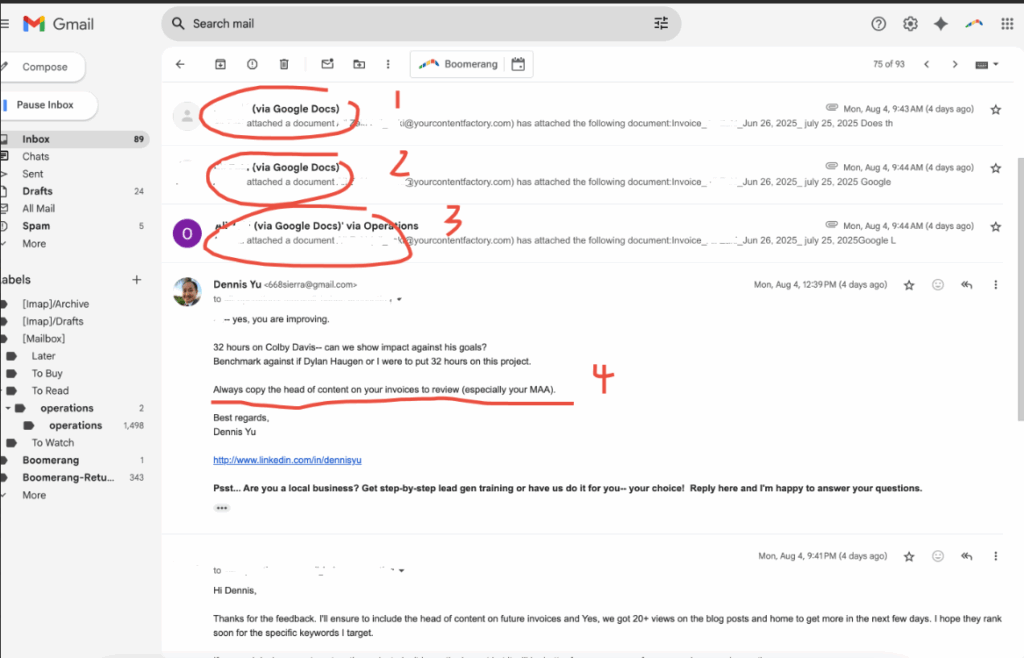
Here are a few real-world examples we’ve picked from emails, with corrections:

1. “Call has already been booked.” vs. “I booked the call, it’s Thursday at 10.”

Who booked the call? I booked the call.

 2. “This email is to confirm that this account is at inbox zero.” vs. “This is Bob confirming that this account is at inbox zero.”

Who sent this email? Bob sent the email.

 3. “More updates to come as these get closed out.” vs. “I will provide more updates as these get closed out.”

Who should we expect updates from? I will send them.

 4. “This thread was moved here” vs. “I moved the thread to here.”

Who moved the thread? I did.

This is less about being picky with grammatical rules and more about being action-oriented.

Passive voice often comes from a mindset of unaccountability, where it’s someone else’s fault, and we don’t step up as owners of our actions.

Do you now see how using direct language ensures everyone is on the same page?
Why Your Follow-Up Is Slowing Things Down

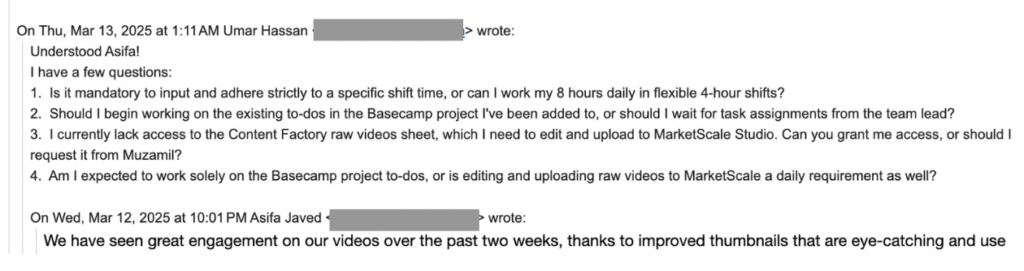
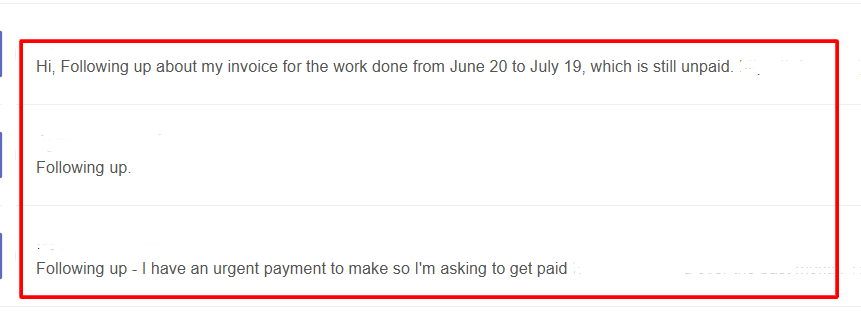
A VA following up multiple times

We all want things done quickly. But in our workflow, repeated follow-ups do not speed things up. In fact, they slow everything down.

The reality

I get over 1,000 emails per day. When you follow-up, which is not necessary with us, you actually slow things down.

The reason why is that we process via first-come, first-served via Boomerang. So when you follow-up, you become the latest request.

Think of it like standing in line at the DMV; if you keep stepping out of line to “check in,” you’re not getting called sooner. You’re starting over.

Why this matters

Following up without reading prior instructions means:

  • The same explanation gets repeated.
  • We waste time fixing things that could have been correct the first time.
  • The burden shifts from solving your request to rescuing it from repeated mistakes.

When you skip steps or ignore the process, you’re effectively saying:

“My time is more valuable than everyone else’s, so I can skip the line.”

That’s not how we work here.

The root cause? Often, it’s about not understanding what a process or system actually is, and how to work within one. This is why we’ve written extensively on:

If you understand these principles, you won’t need to follow up unnecessarily because you’ll know how to get things right the first time.

The correct way to get things done

  1. Read the instructions fully, even the parts you think you already know.
  2. Follow the documented process exactly.
  3. Send it once; with all required details and correct formatting.
A VA not following instructions and repeating the same mistakes

A simple test before you hit “send”

  • Have I re-read last message and followed everything in it?
  • Have I checked for typos, missing names, or skipped steps?
  • Am I sending this only once, with everything needed?

If you can answer “yes” to all three, send it.
If not, fix it first.

Following up multiple times may feel proactive to you. But here, it’s like repeatedly pressing the elevator button, it doesn’t make it come faster. It just makes the ride bumpier for everyone.

Let’s keep things moving smoothly by doing it right the first time.

The Hidden Cost of Mindless “Reply All”

That you shouldn’t reply all unless it’s actually valuable to everyone.
The more people you’re replying to, the more careful you should be.

Jensen Huang, founder of Nvidia — one of the world’s most valuable companies — has a saying:

“If you send it, I will read it.”

We operate the same way. But we only want to read things that help push the ball forward.

If you’ve ever opened your inbox to find a 25-message thread you didn’t need to be on, you already know: the “Reply All” button can be dangerous.

But it’s more than just a minor annoyance– it’s often a symptom of a deeper issue: a team that lacks clarity around roles.

Specifically, who’s ResponsibleAccountableConsulted, or Informed— in other words, a team without clear RACI alignment.

As someone managing over 1,000 emails per day, I spend a huge chunk of my time filtering: What needs my input? What can be delegated? What should just be deleted? All of this wastes valuable time I could be using to build cool things.

Let’s break down what’s really happening here — and how to fix it.

When Reply-All Becomes a Crutch

A new team member recently CC’d the entire company to ask for login info to a specific tool — something only our Ops lead could’ve answered.

Well-intentioned? Sure. Productive? Not at all.

So why do people hit “Reply All” when they don’t need to?

Often, it’s driven by fear or insecurity:

  • “I want people to know I saw this.”
  • “What if they think I’m slacking?”
  • “Better to say something than be silent…”

But in reality, this behavior slows down decision-makingclutters inboxes, and creates a false sense of momentum.

Here’s the kicker: most people don’t realize they’re doing it. They mistake visibility for value.

A RACI Refresher (and Why It Matters)

When roles aren’t clear, everyone feels the need to say something — or worse, no one acts at all. That’s where RACI brings clarity:

  • Responsible: The person doing the work.
  • Accountable: The one who signs off.
  • Consulted: People whose input is needed.
  • Informed: People who should be kept in the loop.

“Reply All” spirals usually happen when everyone starts acting like they’re Consulted — even if they’re just Informed. Or worse, when no one knows who’s truly Responsible.

For example, imagine we need to launch a Facebook Dollar-a-day ad campaign for a client. The team member who’s responsible (R in RACI) should be the one launching it and letting the accountable person know.

But when the accountable team-member isn’t accountable, we have situations where it’s a free-for-all at best, and nothing gets completed at worst.

What It Should Look Like

Let’s say someone sends an update about a project delay.

Here’s how a functional RACI team handles it:

  • The Accountable person makes sure timelines adjust.
  • The Responsible replies (in-thread or privately) with next steps.
  • The Consulted offer insights only if asked.
  • The Informed? They stay silent — and stay informed.

What happens instead?

A flurry of “Thanks!” “Got it!” “Let me know if I can help!” — well-meaning noise that adds zero value.

Think of it like a school project where in a group of 5, two people do all the work while the other three look busy in front of the teacher. Meanwhile, they’re unintentionally slowing down the productivity of the two classmates.

How to Break the Reply-All Habit

Reply-alls and private messages are a tell-tale sign that someone isn’t used to working in a team. It isn’t just a communication problem — it’s a competency problem from us not following RACI etiquette.  

Here’s how to fix it:

  • Set communication norms. If you’re Informed, don’t feel pressure to chime in. Silence is not neglect — it’s discipline.
  • Make RACI roles explicit. Before any task or project kickoff, define who fits where.
  • Pause before replying. Ask: Does this move the task forward? Does everyone need to see this?
  • Use better tools. Slack channels, project boards, or dashboards are better for FYIs than a sprawling email thread.

While overusing “reply all” clogs inboxes and creates noise, the opposite behavior – messaging only Dennis – is often a bigger mistake.

It bypasses the team, creates bottlenecks, and forces Dennis to manually loop others back in. This breaks the system of team accountability and visibility.

Here’s why messaging only Dennis is almost always a mistake.

The Real Problem Isn’t Email

Reply-all is just a symptom. The real issue? A team that lacks competency, structure, and trust.

One of our worst reply-all threads last year involved seven people, two time zones, and three missed deadlines — all because no one knew who owned the task. That mistake cost us a client meeting and a lot of internal friction.

If we want to work with A-Players, we have to communicate like them. That means trusting each other, staying in our lanes, and speaking only when it actually helps.

You don’t need to be loud to be effective. Silence isn’t passive — it’s elite communication, provided you don’t need to be involved. 

You just need to be clear and reliable– which is what actually moves projects along.

Why People Shouldn’t Solo Message Me

If you’re working with our team, whether as a teammate, vendor, contractor, or collaborator, this is for you.

The temptation to DM

I get it. It’s easy to solo message me. I usually reply fast. It feels like the shortest path to an answer. But what seems efficient in the moment often ends up breaking the system we’ve worked hard to build.

We’ve structured things so that communication flows through the right people, not just through me.

I’m not the switchboard

It’s not that I don’t care or don’t want to help. I do. But I get 800+ messages a day, and if everyone treats me like the team’s shortcut, everything slows down.

It’s better, for you and the team, if you go directly to the person responsible. That’s who can actually get it done. You don’t need me as the middleman.

Think like a team

Imagine a hospital where every patient tries to talk directly to the top surgeon for every appointment, follow-up, or billing question. That system breaks immediately. Not because the surgeon doesn’t want to help, but because the whole operation collapses when one person is overloaded.

Same goes here. We built a team for a reason. Everyone has a role, and we need to respect that if we want to move fast and stay sane.

We created the Level 1 Guide to make this easier for new folks, virtual assistants, and anyone unfamiliar with how a high-functioning team operates.

Clients are the exception

Of course, clients can reach out directly. They’re not expected to navigate our internal structure. But internally, we have to hold the line.

We can’t afford to spend time coaching teammates one-on-one when the answers already exist in our training or belong with someone else on the team.

Use RACI

We follow the RACI framework:

  • Responsible – Person doing the task.
  • Accountable – Person answerable for the result.
  • Consulted – People giving input.
  • Informed – People who just need to know.

Most direct messages to me fall into the “I” bucket. That means I don’t need to be asked; I just need to be looped in. And if I’m not the “R” or “A” in the situation, you’re better off messaging someone else.

When people default to messaging me, it creates confusion about who’s actually responsible. It also creates delays, since I’m often not the one doing the work.

How to email like a pro

Need to keep me in the loop? Great. Cc me. That’s all.

But if you need a decision, update, or action, send it to the right person. I’m not ignoring you; I’m making sure the team functions without me needing to play firefighter on every task.

Don’t do this:

  • Email me only, asking for updates or input.

Do this instead:

  • Send the message to the person doing the work. Loop me in as “Informed” only if needed.

Kill the “Reply All” monster

The other common mistake? Hitting reply all like it’s a team sport.

Copying everyone on every message doesn’t help. It muddies the waters and makes it harder to track who’s actually responsible. If everyone’s on the thread, no one’s owning the task.

Before you hit send, ask:

  • Who needs to take action?
  • Who just needs to know?
  • Who doesn’t need to be included?

That’s how high-performing teams communicate on purpose, not on autopilot.

Bottom line

If you’ve been DM’ing me by default, don’t worry, lots of folks start that way. But now you know.

Follow the process. Respect the roles. Use the systems we’ve built. That’s how we scale.

We built the Level 1 VA course to make this easy. Read it. Use it. Become the teammate others want to work with.

How to Turn Complex Ideas Into Something People Can See

Most business owners don’t fail because they’re missing information.
They fail because the message they’re trying to send isn’t being seen the way they think it is.

That point hit me hard during a call with Dennis Yu and Jack Wendt. We were reviewing progress on the cover for our Google Knowledge Panel book that explains the entire process for local service businesses. I was stuck. I kept circling the same surface-level ideas, trying to make technical concepts look visually appealing.

Then Dennis reframed everything.

What he said wasn’t memorized, rehearsed, or scripted. It was him breaking down something simple in a way that cut right to the point:
If people can’t see the idea, they won’t understand it. And if they don’t understand it, they won’t value it.

That single idea changed the direction.

Why Words Weren’t Enough

We already know how to explain the Knowledge Panel system:
how it connects trust signals, organizes your digital presence, and helps Google understand who you are.

But Dennis pointed out that none of that matters unless the business owner can visualize what’s happening.

He compared it to looking at your reflection.

You might have success in the real world—happy clients, strong reviews, awards, a solid reputation—but when you search your own name, the “digital mirror” rarely reflects that truth.
You’ll find outdated information, unrelated people, inconsistent profiles, and mixed-up entities.

The message was simple:
If your reflection is distorted, people won’t see you clearly.

And that’s exactly the point of a Knowledge Panel.

Dennis’s Visual Examples That Changed Everything

Dennis went deeper with a set of visualization examples that helped me finally “see” what he meant:

1. The Reflective Lake

A successful business owner stands at the edge of a lake.
He’s surrounded by gold, 5-star reviews, customer praise—everything that represents real trust.

But when he looks in the water?
He doesn’t see that.

The reflection is blurry, faded, confused.
Waves distort his face.
The image doesn’t match reality.

That’s what Google does when your digital presence isn’t clear.

2. The Foggy Mirror

Imagine a pristine, expensive bathroom inside a beautiful home.
The business owner looks confident—until he looks in the mirror labeled “Google.”

The mirror is fogged over.
You can only see a faint version of his face.
He’s there, but not recognizable.
A faint question mark floats in the condensation.

The outside world sees the room clearly.
The mirror—the digital reflection—is the only thing that’s unclear.

3. The Young Adult “Superman” Transformation

This one also stuck with me.

A quiet, unsure teen walks into a phone booth.
He steps out equipped with the skills, clarity, and confidence needed to help a business owner fix their online presence—almost like a transformation scene.

That’s what High Rise Academy does for young adults, and why our work ties directly into the Knowledge Panel system.

These examples helped me understand what the book and the project need to communicate visually:
Not the mechanics—but the clarity and transformation that business owners actually experience.

The Real Lesson: Clarity Isn’t a Feature. It’s the Foundation.

Dennis explained something I had never fully understood until this call:
people buy clarity, not instructions.

Complex ideas won’t always be understood if the idea isn’t presented in a way they can instantly see. But once you can visualize it everything else clicks into place.

That applies to:

  • The book
  • High Rise Academy
  • How we train young adults
  • How we communicate with business owners
  • Every Knowledge Panel or personal brand project we build

It even applies to how we design covers, thumbnails, and frameworks.
The image has to tell the story before the words ever begin.

Why This Matters for High Rise Influence

High Rise Influence isn’t about showing people a set of tactics.
It’s about helping them understand why their digital identity is unclear—and giving them the tools and people who can fix it.

This moment on the call reminded me why building visuals that communicate the true value matters so much.

The business owner needs to see the gap.
The young adult needs to see the path.
And the brand needs to show both instantly.

That level of clarity changes everything.