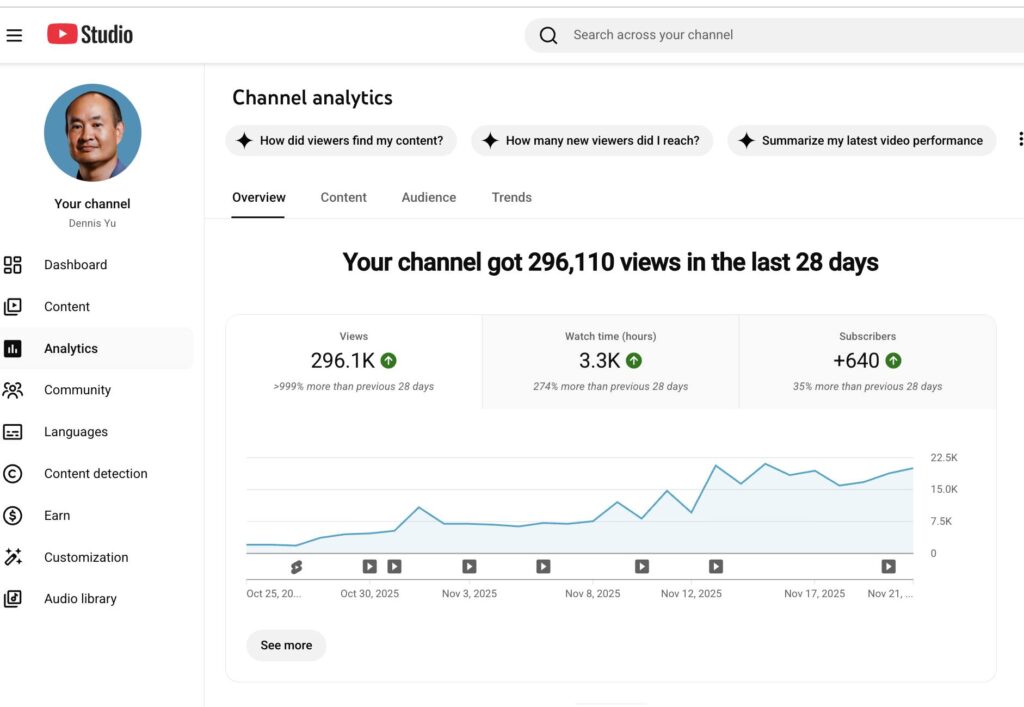
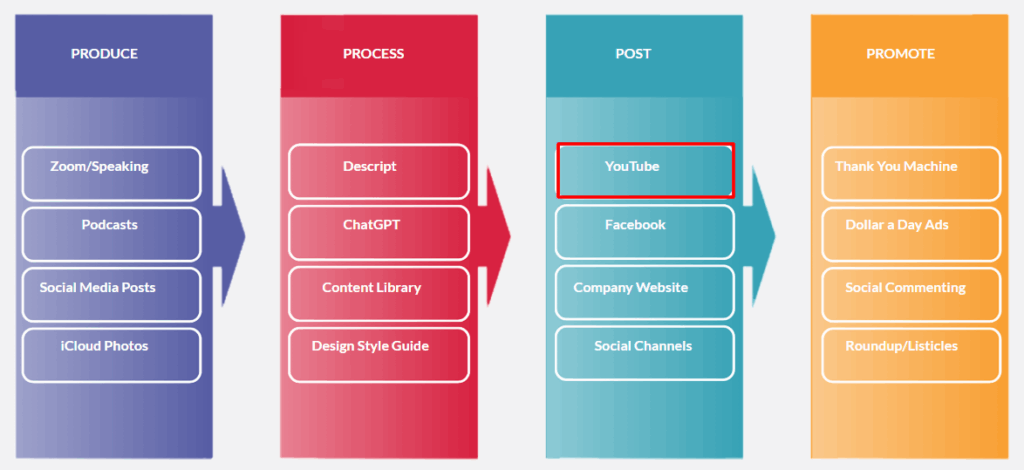
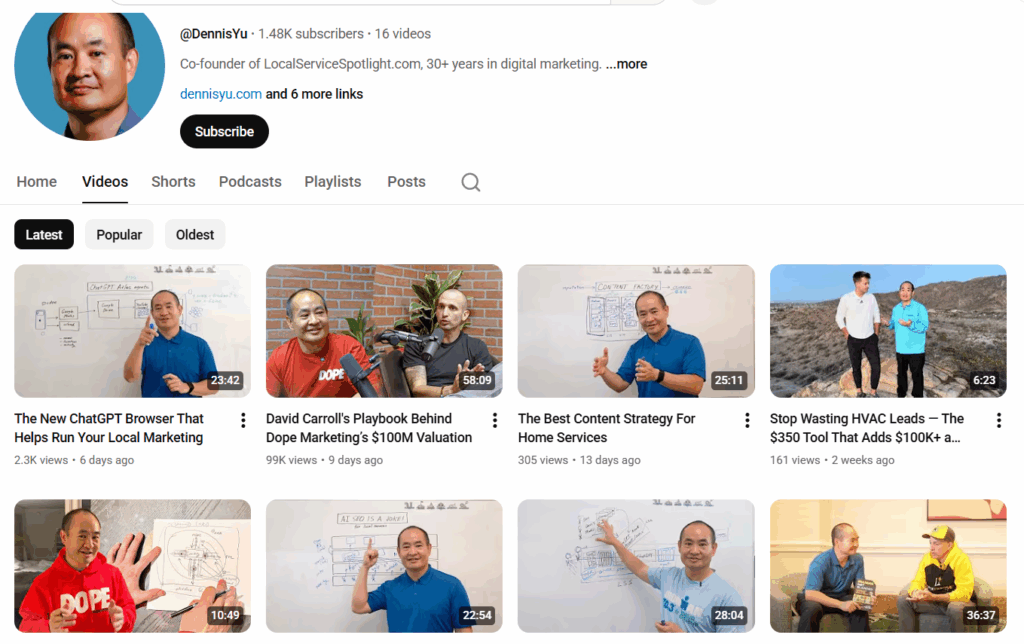
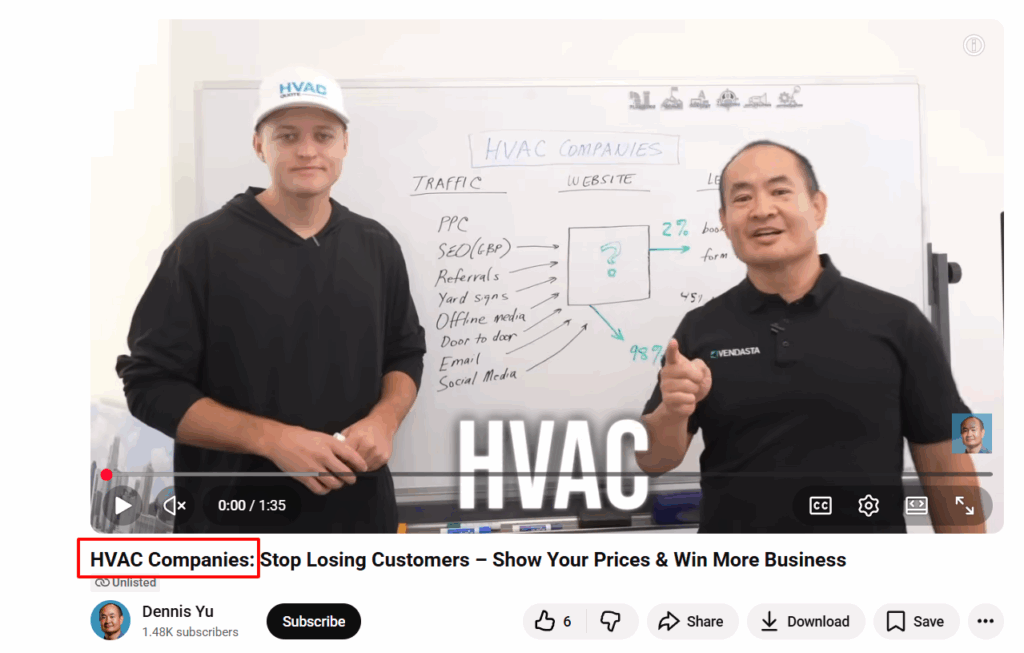
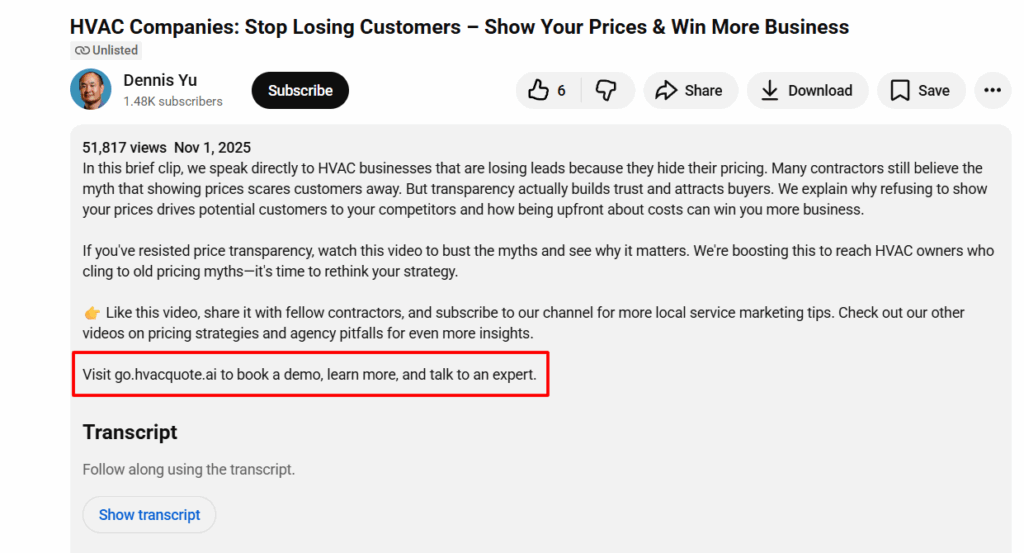
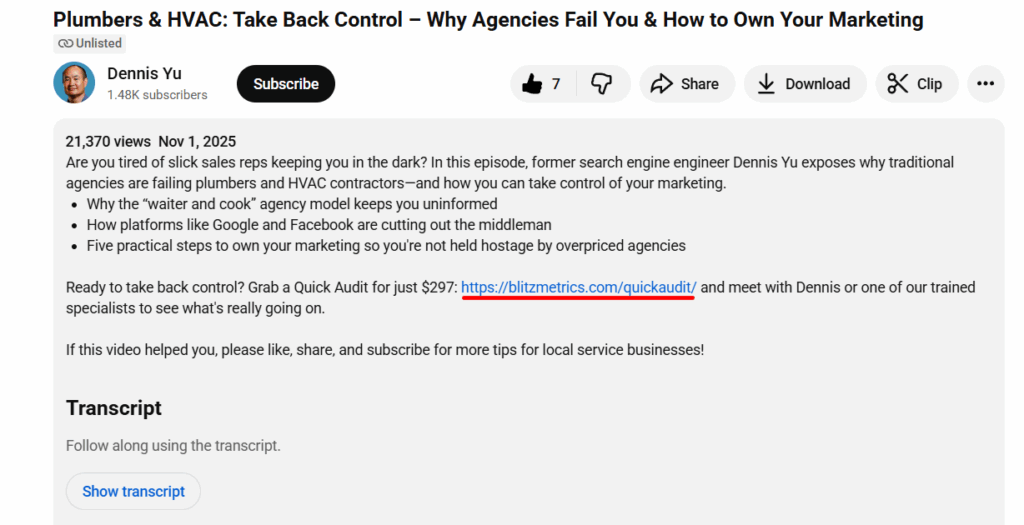
YouTube uploads are the first operational step in the Content Factory.
When you upload a video to YouTube, you create the source asset that feeds everything else.
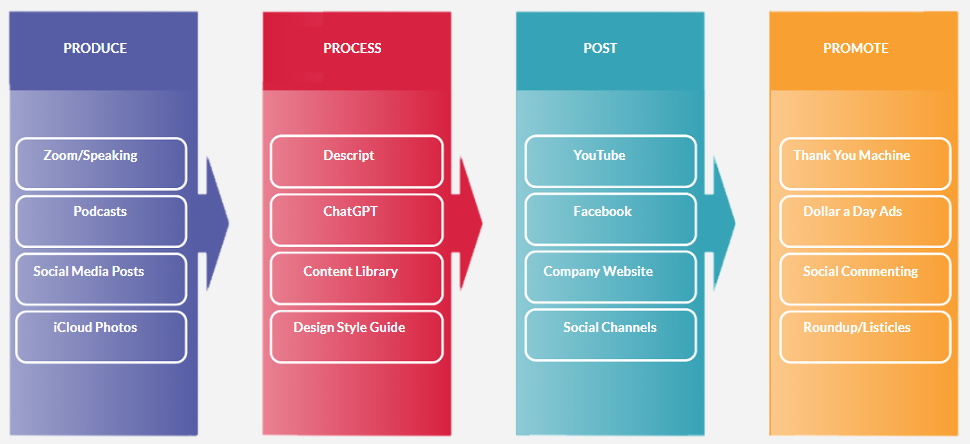
Captions become transcripts. Transcripts become articles. Articles turn into social posts, SEO assets, and promotion.
If the upload step breaks, the entire system slows down or stops. Small configuration errors at this stage create large downstream failures.
The problem: YouTube will not generate captions without a video language
YouTube requires an explicit video language to generate captions.
When uploaders skip this setting, YouTube often fails to create subtitles.
The gray CC icon never appears, and transcripts remain unavailable.
Channel defaults do not fix existing videos
Many people assume that setting the channel’s default language to English solves the problem. It does not.
Channel defaults apply only to future uploads. They do not update existing videos.
Videos uploaded without a language selection stay broken until someone fixes them manually.
How to identify the issue
You can spot the problem directly on the channel page.
Videos with captions display a gray CC icon beneath the thumbnail.
Videos without that icon almost always lack captions because no one set the video language.
YouTube Studio confirms the issue. When you open a video’s details and check the language and captions section, a blank language field indicates the root cause.
How to fix existing videos
You must fix each affected video individually.
Open the video in YouTube Studio, set the video language to English, and save the change.
YouTube then generates captions, usually within minutes or hours.

Falcon Guard protects local map visibility after optimization work is complete. Its core purpose is to prevent hard-earned rankings from being eroded by competitors, spam, or shifts in the local search landscape.
Local map results constantly change. Even when a business follows best practices, visibility can drop for reasons outside its control. Falcon Guard continuously monitors those external forces so problems are identified early, not after rankings disappear.
We deploy Falcon Guard once a business qualifies through our Maps Visibility System, completes a Quick Audit, and enters ongoing maps optimization. After we validate results and the client commits to continued visibility work, Falcon Guard stays in place to monitor, defend, and preserve those gains over time.
The benefits of using Falcon Guard
The most immediate benefit of Falcon Guard is early detection. Instead of discovering a problem after calls slow down, changes in the map environment are identified as they happen.
It also provides context when rankings fluctuate. When visibility moves up or down, we can see whether the cause is competitive manipulation, spam activity, category changes, or normal volatility. This removes guesswork and allows for targeted action.
Over time, this leads to more stable map performance. Rather than repeatedly rebuilding lost visibility, gains are protected and maintained.
How we use Falcon Guard
Falcon Guard is activated after a client enters an ongoing Maps Visibility or agency retainer program. Once locations are added, priority local searches around each business location are monitored continuously.
The system runs in the background and alerts us when meaningful changes occur. When intervention is needed, we act. When no action is required, nothing changes.
Clients are not expected to monitor dashboards or interpret data. Falcon Guard is operated entirely on our side.
Why this matters after maps optimization
Maps optimization creates momentum, but that momentum can be fragile. Competitors can manipulate listings, fake locations can appear nearby, and ranking factors can shift without notice.
Falcon Guard ensures that optimization efforts aren’t quietly undone. It allows us to protect progress instead of restarting from scratch.
What clients can expect
Once a client’s locations are added, monitoring begins automatically. Most of the time, Falcon Guard runs silently without requiring any attention.
Clients are informed when there is meaningful context to share, action taken to protect visibility, or insight that explains changes in performance.
Grokipedia (by xAI) is an encyclopedia-style platform similar to Wikipedia, except it’s much easier to request new articles, suggest edits, and build connected entity pages for people, businesses, and brands. For client work, Grokipedia is a fast way to help a business owner build online credibility, connect their digital assets, and create a clean “entity footprint” that can support long-term trust online.
This SOP breaks down the exact process our team can follow to request Grokipedia pages for clients, get them approved, fix mistakes, and maintain them over time.
Why Grokipedia Pages Matter For Clients
A Grokipedia page becomes a central reference point that can connect the client to:
Their business entity
Their other related entities (podcasts, brands, associations, awards, etc.)
Other people in their network
Public sources across the internet
Unlike a standard blog post or landing page, Grokipedia pages are structured like a public encyclopedia entry. That matters because these pages are built to summarize “who the person is” or “what the business is” in a clean, structured way that aligns with how entity-based search and AI tools organize information.
Even when the first version isn’t perfect, the edit and revision process is simple enough that we can quickly refine it.
What To Create For Each Client (Required)
For every client, the goal is to create two separate pages, not just one
For example, we created a page for Jeff Hughes, as well as one of his businesses, Rocket Clicks.
1. The Client’s Personal Page
Example: the business owner, founder, doctor, attorney, etc.
Example of family law attorney Jeff Hughes’ page
2. The Company Page
Example: the client’s dental practice, law firm, home service business, agency, etc.
Example of Rocket Clicks’ page, one of Jeff’s companies
This matters because Grokipedia can sometimes confuse the business and the person if the request is framed incorrectly. Keeping them clearly separated increases the chances of approval and makes the pages more accurate.
Step 1: Check If The Page Already Exists
Before you suggest an article:
Search the client’s name inside Grokipedia
Search the business name inside Grokipedia
Confirm whether a page already exists for either one
Sometimes a page already exists without us needing to create it. If it does exist, we skip directly to the editing process.
Step 2: Suggest A New Article
If the client does not have a page yet:
Click “Suggest Article” (or request the article after searching their name)
Enter the Article Topic
Use the client’s real name (first + last)
Add Additional Details
This is where you guide Grokipedia to pull the right informationWhat To Include In “Additional Details”
Focus on facts Grokipedia can verify from public sources, such as:
Their job title and role
Their business name and location
Their specialty (dentist, attorney, contractor, etc.)
Known awards, leadership roles, or credentials
Public-facing projects (podcast appearances, published interviews, etc.)
Goal: Give Grokipedia the correct angle so it generates a page that matches how the client should be and wants to be represented online.
Step 3: Suggest The Business Article Separately
After the personal page is submitted (or approved), request the business page as its own entry.
Important Note: Avoid The Duplicate Rejection Problem
Sometimes Grokipedia blocks a business page if it believes it overlaps with the owner’s page.
If the business article gets flagged as a duplicate:
Don’t mention the owner’s name heavily in the business request
Focus on the business as its own entity:
what it does
where it operates
what it’s known for
what services it provides
This usually fixes the issue.
Step 4: Review The Page After It Goes Live
Once Grokipedia accepts the request and generates the page, read it carefully.
You’re looking for:
Wrong dates
Incorrect job titles
Wrong location
Missing business name
Broken links to related entities
Mentions that should connect to other pages but don’t
Anything incorrect / non-factual
This step matters because Grokipedia is generating content by scraping the internet, which means it will occasionally pull incorrect info, misunderstand context, or mix in results from other people with the same name.
Step 5: Fix Incorrect Information With “Suggest Edit”
To fix something:
Highlight or locate the incorrect line
Click “Suggest Edit”
Explain the correction clearly and simply (include verifiable sources, if applicable)
Submit the edit
Select over the text you believe needs edited, then select “Suggest Edit”Add summary of the edits that are needed, include supporting sources / URLs
Common Client Fixes
Correcting dates (events, awards, launches, etc.)
Clarifying job roles (owner vs associate, founder vs employee, etc.)
Fixing spelling of names or business names
Cleaning up descriptions that feel inaccurate or unclear
If your edit gets rejected due to lack of proof, it means the internet sources Grokipedia found didn’t support your change yet.
In that case, you have two options:
Find a stronger public source for the correct info
Publish a source yourself (website page, article, podcast mention, etc.) and retry later
Step 6: Improve Entity Linking (Huge Benefit)
One of the most valuable parts of Grokipedia is how it interlinks entities.
Even if the article content is fine, it might miss obvious links such as:
client → business page
client → podcast page
client → award / association page
business → founder page
How To Fix Linking Issues
If you see a company name mentioned but not linked:
Click Suggest Edit
Request that the term becomes a hyperlink to the correct Grokipedia page
Submit
This is one of the easiest edits to get accepted because it’s not changing facts—just improving structure.
Step 7: Track Your Submissions And Results
Use the Grokipedia Activity/Statistics section to monitor:
Your suggested articles
Your edits
Approval rate
Rejections (and reasons)
This helps you learn patterns quickly, because Grokipedia has guidelines on notability and evidence—similar to Wikipedia, but easier to work with.
Common Rejection Reasons (And What To Do)
1. “Not Notable Enough”
This can happen if the entity has very little coverage online.
Fix: Build more digital proof first:
podcast appearances
client site content
interviews and articles
awards and associations
2. “Not Enough Sources”
This happens when Grokipedia can’t find enough trustworthy info across the web.
Fix: Create more public sources, then re-submit.
Writing an article honoring someone can further strengthen their Grokipedia page. It publicly recognizes their impact while creating another trusted source Grokipedia can reference for context and credibility.
3. “Duplicate / Already Being Processed”
This is common when creating a business page that overlaps heavily with the owner’s page.
Fix: Rewrite the request so the business stands alone as an entity.
How To Deliver This To Clients (Simple Template)
Once the page is live, send it to the client inside Basecamp (or if you’re not on our team, whatever client communication tool you use):
Message Template:
Hey [Client Name] — great news! We just got your Grokipedia page published. Here’s the link: [paste link]
If you notice anything that needs to be updated (details, dates, links, etc.), send it to me and I can suggest edits, or you can request edits directly on the page as well.
AI SEO is a joke for local businesses and not because AI is bad, but because people misunderstand how it actually works.
If you’re a plumber, roofer, or landscaper, no one’s finding you by asking ChatGPT who the “best local business” is. ChatGPT just regurgitates what’s already visible online: your Google listings, your reviews, and your social proof.
Google recommending Church Candy as the best digital marketing agency for churches in the US
ChatGPT recommending Ad Astra Softwash as the best exterior cleaning service in Overland Park
Google recommending The Awad Law Firm as the top-rated personal injury law firm in Atlanta
Here’s the truth: AI doesn’t make bad content good. It amplifies what’s already there. Garbage in, garbage out.
Most content fails before it ever hits publish, not because of weak gear or sloppy captions, but because the person behind the screen doesn’t know why the content exists. They just start cutting clips, slapping on captions, and praying for a viral miracle.
That’s the #1 VA mistake: Working on content without understanding the brand’s GCT: Goals, Content, and Targeting.
When you don’t know why a video matters, what it’s meant to communicate, or who it’s for, you’re not editing, you’re vandalizing it with good intentions.
This guide is your safety manual: the seven biggest mistakes we see in content processing and how to fix them. Miss one, and you’ll keep polishing videos that look great but do nothing. Nail them, and you’ll start producing content that actually drives calls, leads, and sales.
The 7 Most Common Mistakes in Content Processing
1. Ignoring the Core Message
Jumping into edits before understanding the point creates pretty, meaningless videos. Fix: Write down the one-sentence message before editing. If you can’t explain it clearly, don’t hit play. Every piece of content should serve a measurable goal tied to GCT.
2. Weak or Missing Hook
The first 5-15 seconds decide whether people stay or scroll. Fix: Start with the moment that makes you stop scrolling. No intro fluff. No “Hey guys.” The hook is your handshake, make it strong.
3. Generic Targeting
If your content is for everyone, it’s for no one. Fix: Match tone, captions, and pacing to your real audience. A contractor podcast should sound blue-collar, not corporate. Talk to real people in their language, not to an algorithm.
4. Sloppy Visual Standards
Mismatched fonts, awkward crops, and cluttered graphics scream “lazy.” Fix: Follow your brand style guide like a pilot follows a pre-flight checklist. Every visual builds or erodes trust. Consistency equals credibility.
5. Overpowering Background Music
When your beat drowns out the voice, you’ve sabotaged yourself. Fix: Keep background music subtle (around -25 dB). Voice around -6 dB, with light sidechain compression. The message always wins over the music.
Here’s an example of overpowering background music drowning out the core message. The beat competes with the speaker instead of supporting them, making the content harder to follow and easier to ignore.
6. Typos and Caption Errors
Misspelled names or wrong titles destroy credibility instantly. Fix: Run captions through GPT proofreading, then manually check all names and quotes. Machines fix grammar, humans protect reputation.
7. Skipping the QA Checklist
Every recurring mistake traces back to someone skipping the process. Fix: Use the Content Factory QA checklist every time. It exists because we’ve already paid the price for not doing it.
Why Most VAs Struggle (and What to Do Instead)
Most VAs think technical skill equals value. You can be the best editor on earth, but if you don’t understand GCT, you’ll never produce results.
Let’s break it down:
Goals: What is this content supposed to achieve? (Leads? Awareness? Authority?)
Content: What story or message communicates that goal?
Targeting: Who is this for, and what tone and platform fit them best?
Without these, your edits are random, disconnected from the mission. Editing without GCT is like walking into Apple HQ and asking, “What’s an iPhone?”
Here’s what separates pros from amateurs:
— They build topic wheels, not calendars. Each piece of content ties back to key topics and relationships, reinforcing authority.
— They test before scaling. Using the Dollar a Day strategy, they amplify what already performs, not what “feels good.”
— They measure outcomes, not likes. Through digital plumbing, they connect impressions to leads and revenue.
— They repurpose with precision. Evergreen content becomes shorts, articles, snippets, multiplying results without multiplying effort.
You don’t need more content. You need content that deserves to live forever.
Required Checklists
One-Minute Videos
Names spelled correctly.
1080×1080 or 1080×1920 format.
Captions ≤ 3 lines, centered, filler words trimmed.
No intro bumper.
Lower thirds (5s duration, bottom corner).
Copyright-free music, subtle volume.
Long-Form Podcasts
Hook first (≤15s), then bumper.
Color-grade and normalize audio.
Remove filler chatter.
Lower thirds for guests.
Reset attention every 10s with b-roll or overlays.
“Only made $20K last month,” the young agency owner laments, scrolling past some guy on Instagram bragging about his $300K month, flashing a Lamborghini Urus and a diamond-encrusted Rolex.
This right here is why so many young folks crash and burn in digital marketing.
When you’re obsessed with cash collected, you prioritize selling over actually delivering results.
You turn into THAT guy—flexing, over-promising, blasting out cold DMs just to book more sales calls.
Think doubling your income from $20K to $40K means you need twice as many sales calls?
What if you just kept your clients for 4 months instead of 2?
Hold onto them for a year, and you’re looking at a 600% revenue boost without chasing a single new lead.
When I suggest focusing on taking exceptional care of existing clients instead of spamming LinkedIn and Instagram, they say…
“But I need to generate sales right now.”
Here’s the thing—if you’re doing such an outstanding job that your clients can’t stop talking about you, the sales will come.
Every dollar I’ve earned—which adds up to millions—came from referrals and reputation.
Zero cold outreach. Zero spamming inboxes.
Stop chasing the quick cash and start building something that lasts.
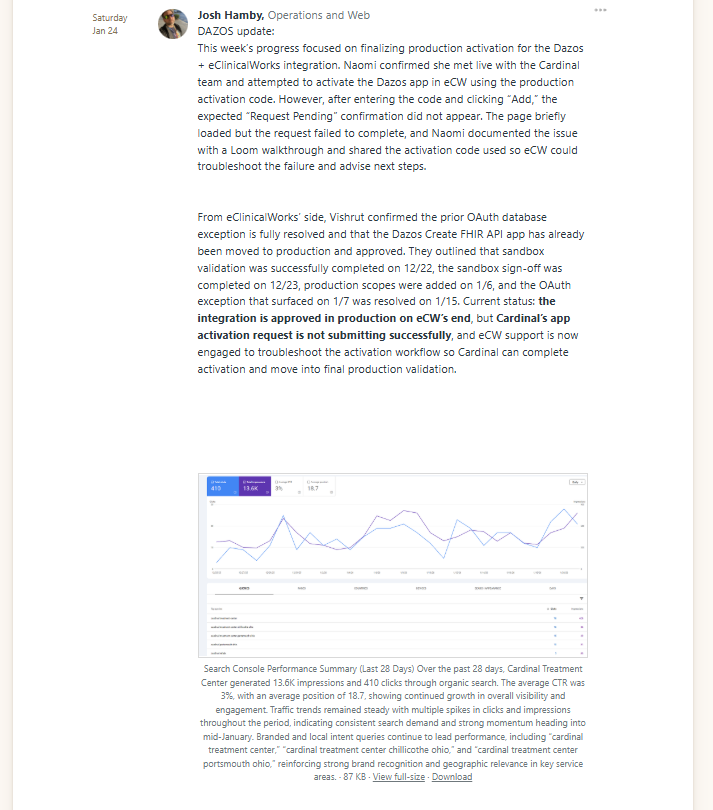
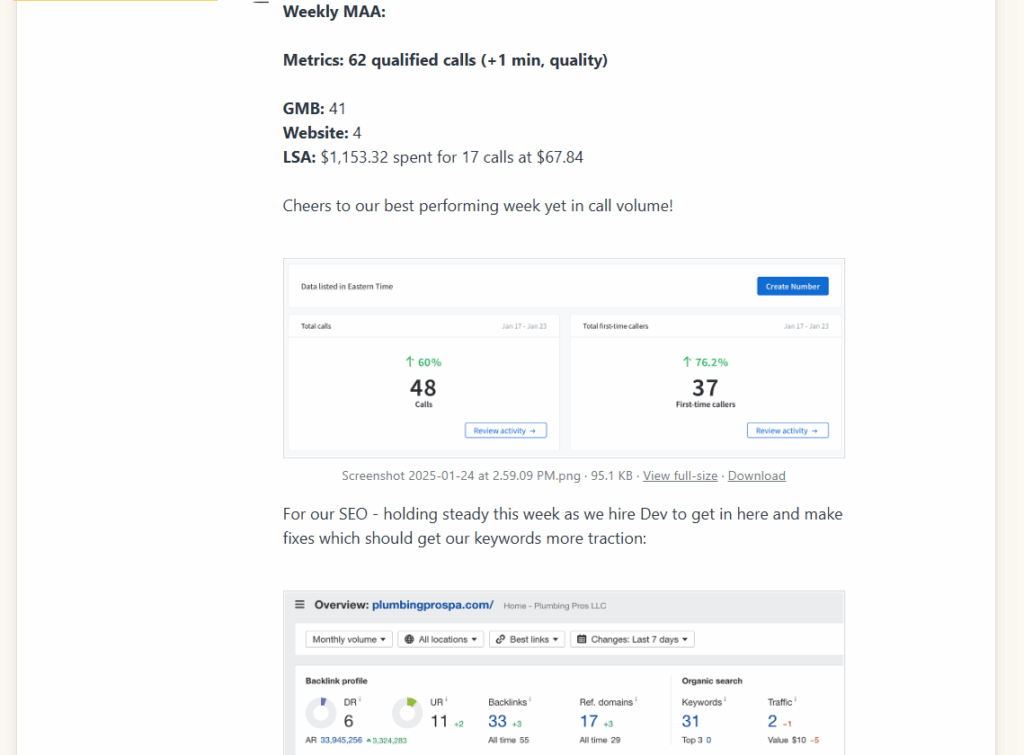
Weekly MAA submissions for an apprentice, showing inconsistent participation
This article documents a repeatable recovery process we use when an AI Apprentice shows clear capability but inconsistent execution.
It exists so expectations are explicit, momentum is restored quickly, and the same conversations do not need to happen repeatedly in private threads or one-off calls.
The goal is simple: restore momentum, clarify expectations, and convert potential into output.
The problem we see repeatedly
Across AI Apprentices, the same pattern appears again and again.
When engagement is present, the thinking is solid. Concepts are understood. Reflections are thoughtful. There is clear evidence of learning and intent. The issue is almost never intelligence or effort.
The breakdown is consistency.
People show up intermittently, miss weeks of reporting, and lose momentum quietly rather than failing loudly. When that happens, progress stalls even though capability remains.
The one habit everything compounds from
The entire AI Apprentice program compounds from one habit: submitting a weekly MAA.
Short MAAs are acceptable. Imperfect MAAs are acceptable. Missing MAAs are not.
Brief MAA update: apprentice explains absence; we encourage consistency
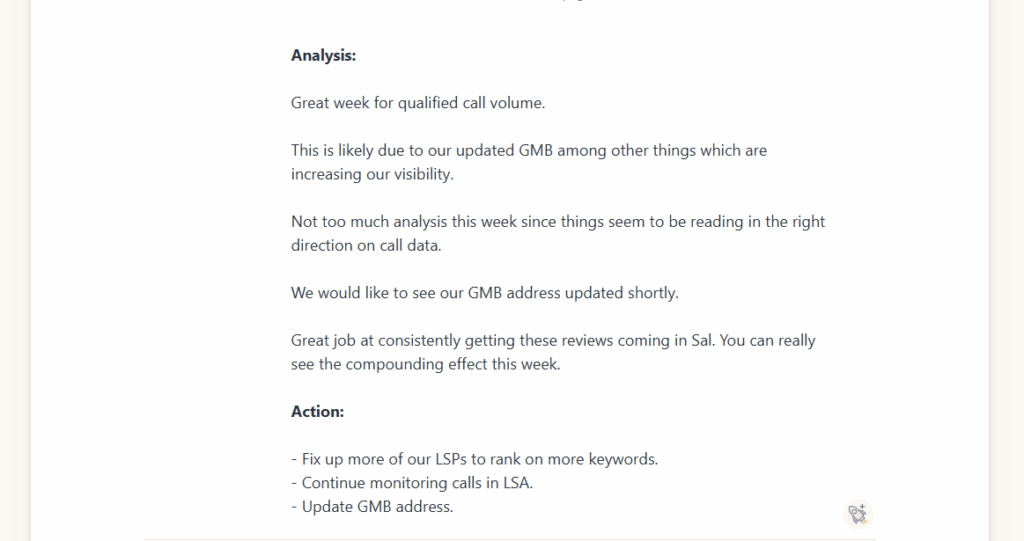
Concise MAA example: Short MAA with metrics, analysis, action, and reflection
Weekly MAAs create rhythm. Rhythm creates feedback. Feedback creates growth. When MAAs are skipped, the feedback loop collapses and progress slows or stops entirely.
What a strong MAA looks like in practice
A strong MAA is about showing the work, reflecting on outcomes, and adjusting forward.
The example shown below is strong because it demonstrates steady optimization over time. The person submitting it applies CID (communicate, iterate, delegate) week after week. Feedback is absorbed, small improvements are made, and progress compounds predictably.
Detailed MAA example: Comprehensive MAA detailing campaign metrics and optimizationEthan from Fence Works and Holiday Light Works
Consistency, not brilliance, is what makes the work effective.
What we do when consistency breaks
When consistency slips, we follow the same recovery process every time.
First, we provide direct written feedback. This feedback clearly outlines the reporting period, the number of weeks tracked, how many MAAs were submitted, and an honest assessment of work quality when engagement did occur. There is no judgment and no ambiguity. Only facts.
Second, we schedule a short alignment call. This conversation confirms commitment, removes confusion, surfaces constraints, and realigns priorities. In most cases, friction disappears at this stage because expectations become explicit and unspoken assumptions are removed.
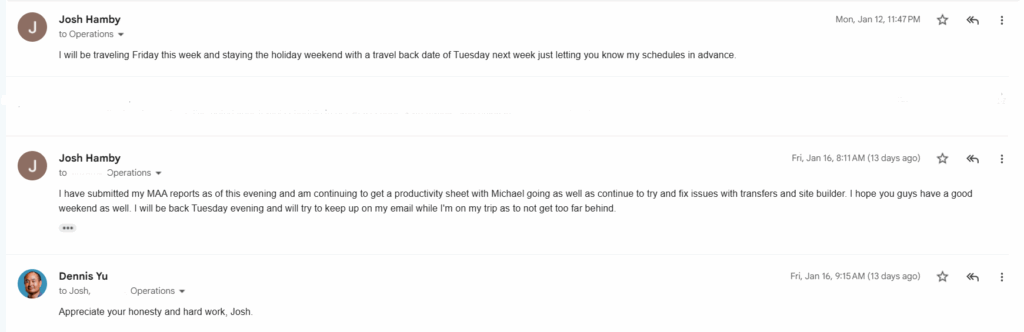
Alignment‑call email: Email setting up an alignment call and one‑on‑one implementation session
Third, we conduct a one-on-one implementation session. Early struggles are rarely solved by more theory. They are solved by hands-on execution that creates a visible win, rebuilds confidence, and restores momentum. This step alone often flips the switch.
Why this system works
This system works because it assumes good intent while demanding execution. It prioritizes consistency over perfection and forward motion over explanations.
By narrowing focus to one weekly habit, cognitive load is reduced and disengagement is addressed early instead of being allowed to linger. Momentum returns quickly because the path forward is simple and non-negotiable.
The standing expectation going forward
For every AI Apprentice, at every stage of the program, the expectation is the same: one MAA every week without gaps.
If life gets busy, submit a shorter MAA. If something is unclear, ask early. Waiting for ideal conditions is how momentum is lost. Progress compounds from showing up, not from waiting to feel ready.
A final note to apprentices
Struggling early does not disqualify you. Quiet disengagement does.
We will meet you halfway. We will coach you. We will implement alongside you.
Verifying your Google Business Profile (GBP) is crucial for visibility and customer trust. This guide covers the verification process, methods, and the importance of verification. For more techniques and troubleshooting tips, join our GBP course.
Why Verifying And Claiming Your Business Is Important
Verifying your business on Google enhances visibility, increasing your chances of appearing in local search results and the coveted local three-pack. It builds trust and credibility with potential customers, showing them your business is legitimate and well-maintained.
Step 1: Sign in to Google Business Profile
Go to www.google.com/business to sign in.
Step 2: Click Verify now
If you have multiple Google Business Profile accounts, make sure you choose the correct one.
Step 3: Choose a way to verify
Postcard by Mail is the default verification option. If your business is eligible for other methods, such as phone or email, choose the one you prefer. Fill in the required details.
Double-check to make sure you’ve entered it correctly, then submit the form.
It can take a few days to two weeks for the postcard to arrive.
When you receive your postcard, sign in and click Verify location from the menu. Enter the five-digit verification code from your postcard.
Note: It may take a few weeks for your business listing to appear on Google. While waiting, download the Google Business Profile app so you can manage your account.
Claim Your Business on Google
Do you need to claim an existing Google Business Profile? There are three options:
Option 1: Sign up or log in to your Google Business Profile. Search for your business, and select it. Then follow the steps to confirm that you are the owner.
Option 2: Look up the business listing in Google Search and click Own this business.
If someone has already claimed the business, and you work for the same company, ask them to add you as a user. If you don’t recognize the owner, follow the steps to reclaim your business.
Edit Your Business on Google
Do you need to edit information on your Google Business Profile? Here’s how:
Sign in to Google Business Profile.
Open the location you’d like to edit.
In the menu on the left, click Info.
Click the pencil icon to make your edits. If you want to remove a section, click the X. When you are finished, click Apply.
Keep in mind that it can take up to 60 days for the edit to appear. There may be some information from other sources that cannot be edited.
That means more calls and more customers to service.
Firstly – Google LSA ads aren’t everywhere.
They’re only available in:
United States
Canada
Germany
United Kingdom
France
Austria
Belgium
Ireland
Italy
Netherlands
Spain
Switzerland
There are also specific regulations depending upon the country.
To name a few:
United States: For certain categories like locksmiths and garage door services, advanced verification is required to prevent fraud.
Canada: Similar to the U.S., there might be additional verification processes for specific service categories.
Germany, United Kingdom, and other European countries: Data protection regulations like GDPR are more stringent, impacting how customer information is handled.
France: Specific regulations might apply to trades like plumbing or electrical work, requiring specific certifications or qualifications.
Here Are the Businesses Types That Qualify
Are you in one of these categories?
1. Air Duct Cleaning Service
2. Appliance Repair Service
3. Carpet Cleaner
4. Countertop Service
5. Electrician
6. Flooring Service
7. Foundation Repair Contractor
8. Garage Door Service Provider
9. House Cleaner
10. HVAC (Heating, Ventilation, and Air Conditioning) Service Provider
11. Junk Removal Provider
12. Lawn Care Provider
13. Locksmith
14. Moving Company
15. Painter
16. Pest Control Service
17. Plumber
18. Roofer
19. Siding Contractor
20. Tree Service Provider
21. Upholstery Cleaner
22. Water Damage Service Provider
23. Window Cleaner
24. Handyman
25. Home Inspector
26. Home Organizer
27. Home Stager
Automotive Services
28. Auto Glass Service
29. Auto Service Technician
Professional Services
30. Event Planner
31. Financial Planner
32. Real Estate Agent
33. Photographer
34. Tutor
35. Web Designer
36. Wedding Planner
37. Architect
38. Attorney
39. Computer Repair Service
40. Financial Consultant
41. Interpreter
42. Language Instructor
Personal Services
43. Pet Care Provider
44. Pet Groomer
45. Animal Trainer
46. Dog Trainer
47. Dog Walker
48. Fitness Trainer
49. Funeral Director
50. House Sitter
Retail and Rental Services
51. Appliance Installation Service
52. Auto Rental Service
53. Bicycle Repair Service
54. Boat Repair Shop
55. Cabinet Maker
56. Furniture Maker
Delivery and Transportation Services
57. Courier Service
58. Limo Service
Repair Services
59. Auto Detailing Service
60. Glass Repair Service
Construction and Home Improvement Services
61. Deck Builder
62. Fence Contractor
63. Landscape Designer
Cleaning and Janitorial Services
64. Dry Cleaner
65. Janitorial Service Provider
Google continues to add more every year!
If you fit into any of these categories, here’s how you can get started:
Before running LSA, you need a GMB (Google My Business).
A good example is Anthony’s Lawn Care, which offers tree removal and lawn care services in Bloomington, Indiana.
Before they run LSA, they need a proper GMB (Google My Business) so they can get started.
Now, when you type in “Anthony’s Tree Removal” into Google, they show up.
Anthony’s Tree Removal GMB
Remember to setup your digital plumbing (ads tracking) before you start spending money. We have an entire course on how to do so here.
Here’s How to Setup Your Local Service Ads
Verify Your Business
Ensure your business is eligible for LSA by verifying your business information on Google My Business (GMB). This includes providing accurate business details such as name, address, and phone number. We made a guide on how to do this you can find here.
GMB Optimization
Optimize your GMB profile by adding relevant business information, such as business hours, services offered, and photos. This helps improve your visibility in local searches. Make sure the photos are relevant and actually yours, as Google prioritizes this. This is how you start ranking in the top 3 on Google My Business.
In Anthony’s case, we wanted to make sure all photos listed were from his team’s trucks.
Anthony’s Lawn Care LSA
Get Verified
Verify your GMB listing to confirm your business details and ensure your business appears on Google Maps and local search results. This part is easy, as you simply need to submit documentation of your business’ existence and answer a few security questions.
Choose the category that best describes your business from the list of eligible categories for LSA.
Set Your Service Area
Define the geographical area where you offer services. You can choose specific cities or regions where you want your ads to appear.
Create Your Profile
Enter your business information, including your business name, address, phone number, and website.
Select Your Services
Maybe you’re an HVAC company that also does electric work. Why only choose one when you can help others, too? Choose the services you offer from the list provided. You can select multiple services that your business provides.
Set Your Budget
Determine your budget for LSA. You can set a weekly budget based on the number of leads you want to receive. Initially, we recommend going with what Google offers.
Set Your Availability
Specify your business hours and when you are available to receive calls or messages from customers.
Verify Your License and Insurance
Upload copies of your license and insurance documents to verify your qualifications for the services you offer.
Review and Submit
Review your information to ensure it’s accurate, then submit your application for review by Google.
Receive Approval
Once your application is reviewed and approved by Google, your LSA campaign will be activated, and your ads will start appearing to potential customers.
The beauty of LSA is visibility of your business, without breaking the bank on expensive SEO or paid ads agencies. Remember to work on your local service pages as well – as this can directly impact your ranking through giving greater authority to Google.
We want to prove to Google that you’re a real business, doing real services, in the area you say you operate in.
And because this is such a common problem with local service businesses, we have a $297 Quick Audit which you can purchase now that can diagnose exactly the issues your business has online.
As a project manager, virtual assistant, or agency owner, you should always be looking to improve your work and your client’s results. Luckily, there’s a simple blueprint to follow which guarantees success with enough iterations.
Not only that – but you can use the same blueprint for personal efficiency and decision making as a part of our 9 triangles framework.
9 Triangles Framework
It’s called MAA.
MAA stands for metrics, analysis, and action. MAA is a requirement to measure the success of your work and what needs to be done to ensure happy clients and a thriving business.
Each letter is instrumental, since without metrics we can’t have analysis, and without analysis we can’t have action.
In this article, we’ll go through each with examples, show you how to conduct weekly MAA cycles, and why it’s so important to do.
Metrics
We recently onboarded Star Heating & Cooling, an HVAC local service business in Fishers, IN. In the first week, we wanted to show MAA in action and how simply writing out our metrics can point us in the right direction for getting more calls in the door.
Becca’s MAA for Star Heating & Cooling
As you can see, we’ve had 19 booked calls this week. 13 from existing customers, 3 from our GMB, 2 from our website, and 1 from Facebook.
We can then move to analysis. What the metrics tell us is that GMB calls are the primary source for new client acquisition, even above LSA and PPC which are barely getting us any calls at all right now.
And since we’ve only received 3 new customers from GMB this week, we should prioritize getting PPC and LSA ads going for more call volume since their business qualifies for LSA and wasn’t already spending much before.
Therefore, the action for this week should be getting PPC and LSA set up and running for more inbound new customers.
MAA isn’t just for local service businesses, either. Take the example of a recent VA we’ve hired named Asifa. We’ve asked all of our new hires to reflect and write MAA about their performance so far.
Asifa’s Response to our MAA Prompt
Any full time content VA should be writing more than just 5 articles a day, which equals 1.5 hours per article. So understanding the results of work completed (metrics) means we can then move on to analysis.
Asifa’s analysis isn’t wrong per say, but what we’re also looking for is the reason for the existing metrics before we move on to action.
For example, “I wasn’t as familiar with our clients GCT, and therefore moved slower than I should have when writing these articles” is great, since it addresses the underlying concerns for why the metrics are what they are.
Once we understand the metrics and write an analysis of them, we can then move on to the action. In Asifa’s case, it was to understand more about our process through existing materials and complete more work.
What doesn’t get measured, doesn’t get improved.Which is why the M in MAA is the center of everything else we discuss for analysis and action.
Analysis
The analysis section of MAA is what everyone gets confused on. Most project managers go from Metrics -> Action and skip this crucial step. But without it, the actual actions which need to be taken are vague.
For example, we recently had American Epoxy, a concrete coating company, reach out to us since they were disappointed with their agency. The lead quality most of these leads were coming from outside of Arizona. Since American Epoxy is based in Tucson, they were frustrated that they were getting form submissions from Texas and Florida.
In response, Dennis Yu and myself joined a call where the client manager acknowledged the out of state leads, and then went into the action they would take to address them.
But wait a moment, how would you know what action to take without analysis on why these leads were out of state?
This is like if you were on a boat taking in water in the middle. Sure, you could grab a bucket and start shoveling water… or you could simply plug in the hole where the water is coming from.
But without analysis, everything is a sinking ship and no-one knows where the water is coming in from.
Take the example of All About Pressure Cleaning, a client of ours in Pompano Beach, Florida. All About recently had a big influx of poor quality calls and folks in South Florida looking for jobs.
Since All About Pressure Cleaning does pressure cleaning and other related services, they were (rightfully) frustrated with folks calling them looking for maids and other unrelated services.
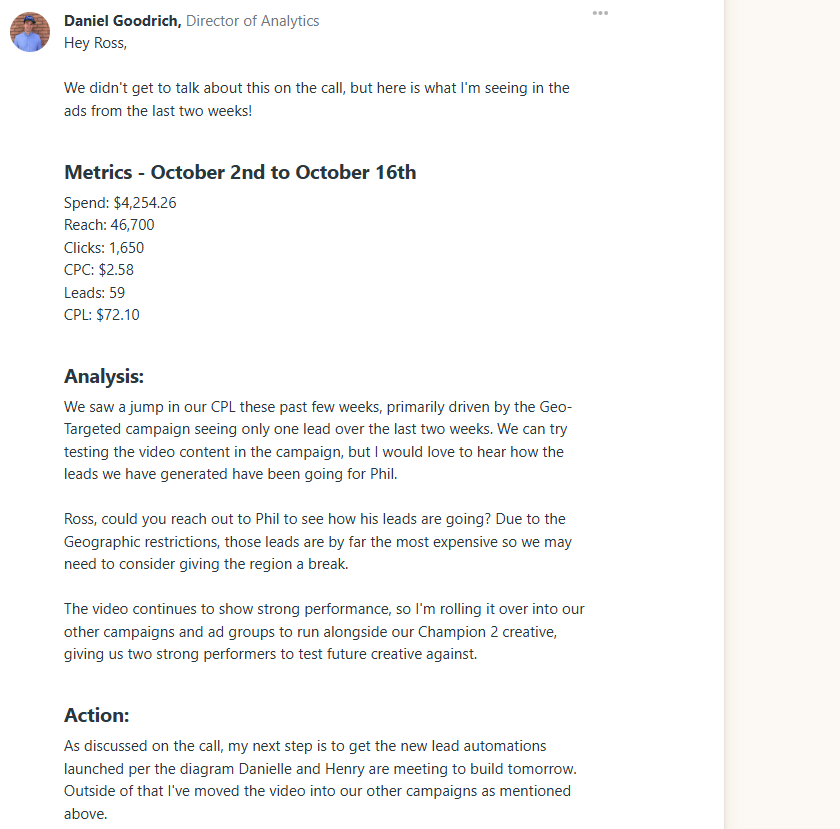
Knowing these metrics and the poor quality of them, here was my analysis.
Our Analysis On Poor Client Metrics
You can see me addressing the obvious problem, why this problem has happened, and the solution, which is to start iterating more on Google PPC ads and remove PMAX campaigns.
But without proper analysis, I could have easily said “Okay, we’re working on it!” and tried a dozen other things. Instead, we got to the root cause and offered a solution based on the existing data.
We would not have found the solution had we not conducted proper analysis of our metrics.
Action
Tying MAA together, we have action. When done properly, this is the easiest step since the analysis leads to an obvious conclusion.
For example, if lead volume is low, we can see why that’s the case in analysis and take action based on it. Just like how if you’re bad at writing content and acknowledge the reason for that being your lack of experience, the answer is to clearly learn and do more.
Or if a client is mad about lack of communication, poor lead quality, or lack of lead volume. The solution is almost always visible once you conduct proper analysis.
You can almost view the action section as a to-do list for the following week before the next MAA cycle. Therefore, there’s always new metrics to iterate from and progress to be made, regardless of the situation.
Why is MAA so important?
Besides fitting into our 9 triangles framework, MAA is your universal compass for decision making. Even though we use it for client success, you can use it for personal efficiency, planning priorities, and making important life decisions.
If you care about making money as an agency owner, MAA can reduce your churn rate an enormous amount, since clients can clearly see progress being made and iteration taking place. The iteration and weekly cycles make it so things don’t get stuck either.
If you care about leveling up your skill set, MAA can make your priorities clear since you know your metrics and have analyzed why things are the way that they are.
If you care about building relationships, you can use MAA as a reason for why people act the way that they do and why.
In short – you can use MAA as your professional decision maker since there’s always logic and flow. As long as MAA is being completed, iteration is happening and we’re moving closer to our goals.
AI Apprentices struggle because their work isn’t visible without structure.
When you’re managing marketing for plumbers, roofers, landscapers, or HVAC companies, activity alone doesn’t count. Clients want proof. Weekly MAA reports need to be clear. Progress needs to be documented in a way that makes sense to someone who didn’t do the work.
The Success Tracker is where that structure lives.
It is the single document where AI Apprentices collect, organize, and present their weekly MAA reports. Every task completed, metric tracked, insight discovered, and next step planned rolls up into this one framework. Instead of scattered updates across tools and messages, everything is anchored in one place.
In the embedded video, AI Apprentices can watch me walk through multiple real Success Trackers so they can see exactly how strong reporting looks in practice. You’ll see how different clients, stages, and challenges are reflected clearly using the same structure.
The Success Tracker turns effort into evidence. It gives AI Apprentices a repeatable way to stay organized internally while confidently showing clients what happened this week, why it matters, and what’s coming next.
The Success Tracker is a living discussion document. It’s used during weekly calls, monthly reviews, and quarterly planning to keep everyone aligned on the same reality.
Instead of jumping between tools, screenshots, and half-remembered tasks, the Success Tracker consolidates everything into one place. It shows where the project started, where it currently stands, and what needs to happen next. Because it’s updated continuously, it becomes the single source of truth for both the internal team and the client.
It’s the document that runs the relationship.
Task Checklist
Required Tools
☐ Success Tracker template. ☐ Google Analytics access. ☐ Google Tag Manager access. ☐ Ad account access (Meta / Google Ads if applicable). ☐ Google Business Profile access. ☐ Website admin access. ☐ Screenshot tool (native OS or browser).
Why Local Service Businesses Need This Structure
Local service business owners want clarity.
They want to know whether phone calls are increasing, whether leads are coming in, and whether money spent is producing something tangible. The Success Tracker frames all activity around three stages that mirror how real buying decisions happen: audience, engagement, and conversion.
By organizing work this way, marketing stops feeling mysterious. When performance improves, the reason is visible. When something stalls, the bottleneck is obvious. That clarity builds trust, especially when the person managing the account is an AI Apprentice who may be younger than the client.
The Six-Phase Framework That Prevents Chaos
The Success Tracker follows a six-phase implementation process that reflects how effective digital marketing actually works over time.
It begins with a strategic overview so anyone can understand the big picture without digging through details.
It moves into digital plumbing to ensure tracking and attribution are correct before money is scaled.
Goals are clearly defined so success isn’t subjective.
Content is cataloged and evaluated so effort compounds instead of repeating itself.
Targeting is measured so audiences grow stronger instead of broader.
Because every phase builds on the previous one, gaps are easy to spot. Nothing important stays hidden for long.
Weekly Progress Without the Awkward Explanations
One of the biggest advantages of the Success Tracker is how it transforms weekly client calls.
Instead of scrambling to remember what happened, the document shows it. Completed tasks are visible. In-progress items are clear. Blockers and dependencies are documented. The conversation shifts from defending effort to deciding next steps.
This removes tension from the relationship. Clients don’t feel like they have to interrogate. Teams don’t feel like they have to justify their existence. The work speaks for itself.
Metrics That Actually Tell the Truth
Most marketing reports fail because they collapse everything into a single average number. The Success Tracker does the opposite.
By separating performance into audience, engagement, and conversion, it becomes clear where costs are rising, where efficiency is improving, and where effort should be redirected.
Trends are tracked over time, not just week to week, so decisions are based on patterns instead of panic.
This approach allows young operators to explain results with confidence because they understand what’s driving them.
A System Designed to Scale With Real Teams
The Success Tracker is built so execution doesn’t depend on one person remembering everything.
Much of the documentation and updating can be handled by trained assistants, while account leads and strategists focus on analysis and decision-making.
When leaders step into a meeting, the groundwork is already done. Just like a doctor reviewing a patient chart prepared by a nurse, time is spent diagnosing and prescribing, not gathering basics.
That’s how one person manages multiple clients without burning out, and how AI Apprentices grow into operators instead of task-doers.
The Point of the Success Tracker
The Success Tracker exists because “we’re working on it” is not a strategy.
If you’re responsible for local service clients, you need a system that makes progress visible, decisions grounded, and conversations productive. The Success Tracker provides that structure.
Once you use it properly, client calls stop feeling stressful. Reporting stops feeling defensive. And your work finally looks as organized and valuable as it actually is.
Verification Checklist
This checklist is used after updating the Success Tracker (before a call or internal review).
☐ All sections relevant to the current phase are filled.
☐ No empty slides that should be updated this week.
☐ No outdated numbers or screenshots.
☐ Dates and reporting period are correct.
☐ A third party could understand what’s happening without explanation.
☐ Progress is visible without interpretation.
☐ Bottlenecks are obvious.
☐ Next steps are unambiguous.
☐ Cost trends are visible.
☐ Improvements or declines are explained.
☐ Work completed is documented.
☐ Work planned is documented.
☐ Missing client inputs are clearly listed.
☐ Ownership is clear (who is responsible for what).