How to Do MAA (Metrics, Analysis, Action) Like a Pro

As a project manager, virtual assistant, or agency owner, you should always be looking to improve your work and your client’s results. Luckily, there’s a simple blueprint to follow which guarantees success with enough iterations.
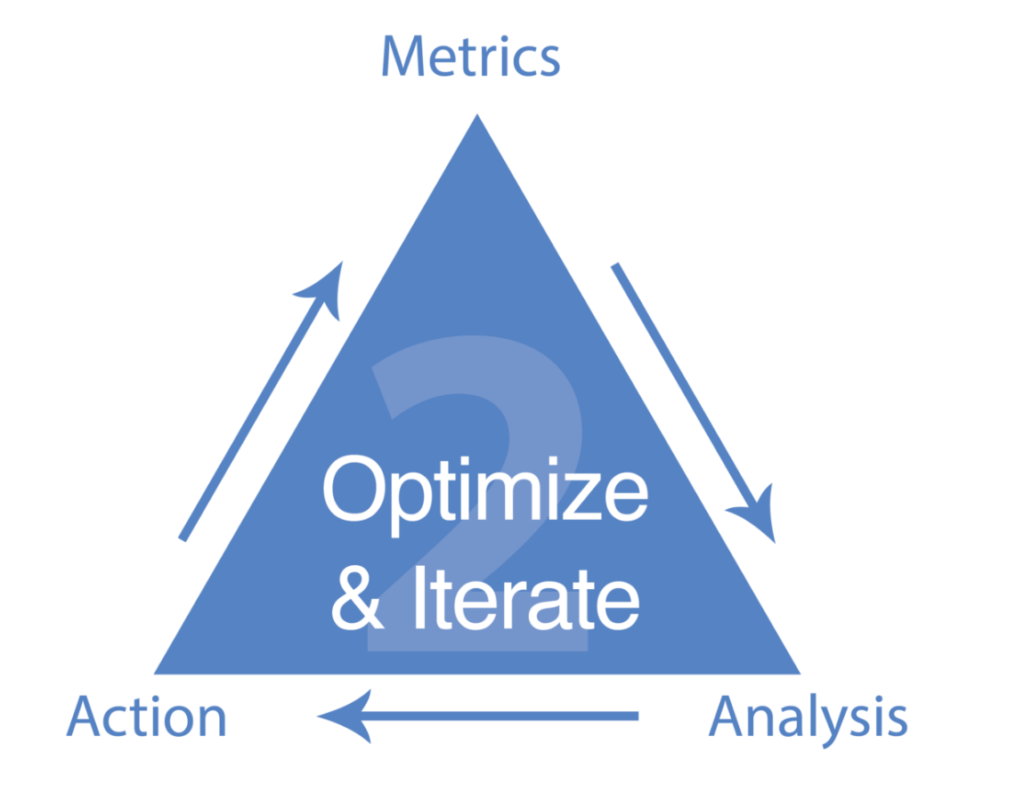
Not only that – but you can use the same blueprint for personal efficiency and decision making as a part of our 9 triangles framework.
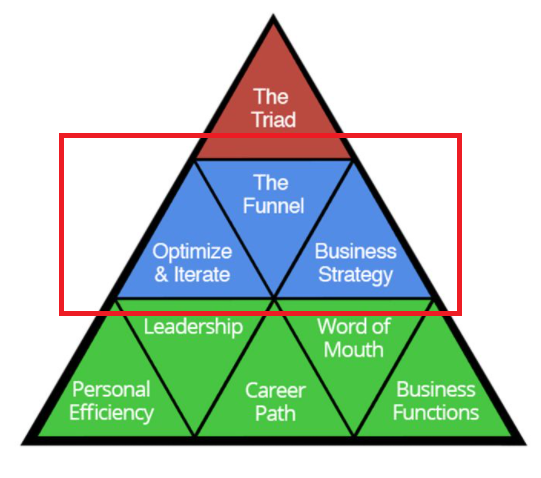
It’s called MAA.
MAA stands for metrics, analysis, and action. MAA is a requirement to measure the success of your work and what needs to be done to ensure happy clients and a thriving business.
Each letter is instrumental, since without metrics we can’t have analysis, and without analysis we can’t have action.
In this article, we’ll go through each with examples, show you how to conduct weekly MAA cycles, and why it’s so important to do.
Metrics
We recently onboarded Star Heating & Cooling, an HVAC local service business in Fishers, IN. In the first week, we wanted to show MAA in action and how simply writing out our metrics can point us in the right direction for getting more calls in the door.
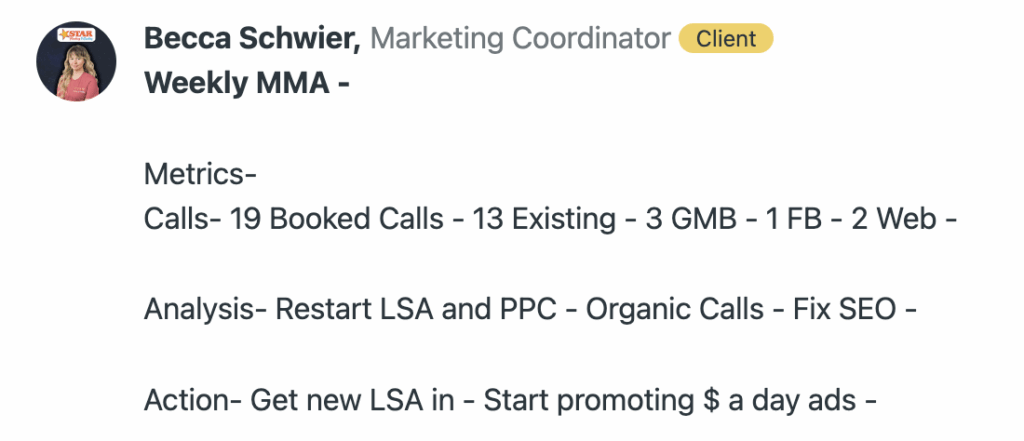
As you can see, we’ve had 19 booked calls this week. 13 from existing customers, 3 from our GMB, 2 from our website, and 1 from Facebook.
We can then move to analysis. What the metrics tell us is that GMB calls are the primary source for new client acquisition, even above LSA and PPC which are barely getting us any calls at all right now.
And since we’ve only received 3 new customers from GMB this week, we should prioritize getting PPC and LSA ads going for more call volume since their business qualifies for LSA and wasn’t already spending much before.
Therefore, the action for this week should be getting PPC and LSA set up and running for more inbound new customers.
MAA isn’t just for local service businesses, either. Take the example of a recent VA we’ve hired named Asifa. We’ve asked all of our new hires to reflect and write MAA about their performance so far.
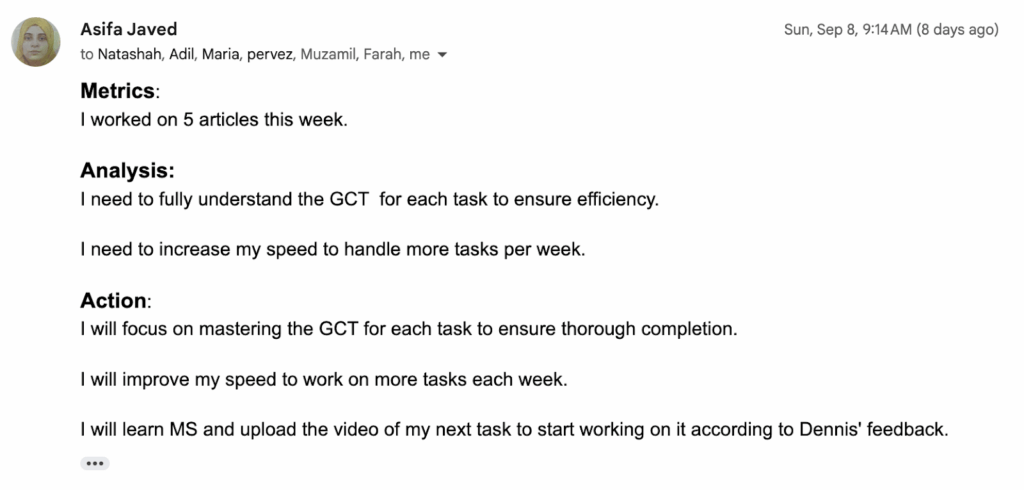
Any full time content VA should be writing more than just 5 articles a day, which equals 1.5 hours per article. So understanding the results of work completed (metrics) means we can then move on to analysis.
Asifa’s analysis isn’t wrong per say, but what we’re also looking for is the reason for the existing metrics before we move on to action.
For example, “I wasn’t as familiar with our clients GCT, and therefore moved slower than I should have when writing these articles” is great, since it addresses the underlying concerns for why the metrics are what they are.
Once we understand the metrics and write an analysis of them, we can then move on to the action. In Asifa’s case, it was to understand more about our process through existing materials and complete more work.
What doesn’t get measured, doesn’t get improved. Which is why the M in MAA is the center of everything else we discuss for analysis and action.
Analysis
The analysis section of MAA is what everyone gets confused on. Most project managers go from Metrics -> Action and skip this crucial step. But without it, the actual actions which need to be taken are vague.
For example, we recently had American Epoxy, a concrete coating company, reach out to us since they were disappointed with their agency. The lead quality most of these leads were coming from outside of Arizona. Since American Epoxy is based in Tucson, they were frustrated that they were getting form submissions from Texas and Florida.
In response, Dennis Yu and myself joined a call where the client manager acknowledged the out of state leads, and then went into the action they would take to address them.
But wait a moment, how would you know what action to take without analysis on why these leads were out of state?
This is like if you were on a boat taking in water in the middle. Sure, you could grab a bucket and start shoveling water… or you could simply plug in the hole where the water is coming from.
But without analysis, everything is a sinking ship and no-one knows where the water is coming in from.
Take the example of All About Pressure Cleaning, a client of ours in Pompano Beach, Florida. All About recently had a big influx of poor quality calls and folks in South Florida looking for jobs.
Since All About Pressure Cleaning does pressure cleaning and other related services, they were (rightfully) frustrated with folks calling them looking for maids and other unrelated services.
Knowing these metrics and the poor quality of them, here was my analysis.

You can see me addressing the obvious problem, why this problem has happened, and the solution, which is to start iterating more on Google PPC ads and remove PMAX campaigns.
But without proper analysis, I could have easily said “Okay, we’re working on it!” and tried a dozen other things. Instead, we got to the root cause and offered a solution based on the existing data.
We would not have found the solution had we not conducted proper analysis of our metrics.
Action
Tying MAA together, we have action. When done properly, this is the easiest step since the analysis leads to an obvious conclusion.
For example, if lead volume is low, we can see why that’s the case in analysis and take action based on it. Just like how if you’re bad at writing content and acknowledge the reason for that being your lack of experience, the answer is to clearly learn and do more.
Or if a client is mad about lack of communication, poor lead quality, or lack of lead volume. The solution is almost always visible once you conduct proper analysis.
You can almost view the action section as a to-do list for the following week before the next MAA cycle. Therefore, there’s always new metrics to iterate from and progress to be made, regardless of the situation.
Why is MAA so important?
Besides fitting into our 9 triangles framework, MAA is your universal compass for decision making. Even though we use it for client success, you can use it for personal efficiency, planning priorities, and making important life decisions.
If you care about making money as an agency owner, MAA can reduce your churn rate an enormous amount, since clients can clearly see progress being made and iteration taking place. The iteration and weekly cycles make it so things don’t get stuck either.
If you care about leveling up your skill set, MAA can make your priorities clear since you know your metrics and have analyzed why things are the way that they are.
If you care about building relationships, you can use MAA as a reason for why people act the way that they do and why.
In short – you can use MAA as your professional decision maker since there’s always logic and flow. As long as MAA is being completed, iteration is happening and we’re moving closer to our goals.
If you’d like to learn more, we have a whole course on how to do MAA, with even more examples and blueprints.