
How Dennis Yu Is Building the Uber of Digital Marketing

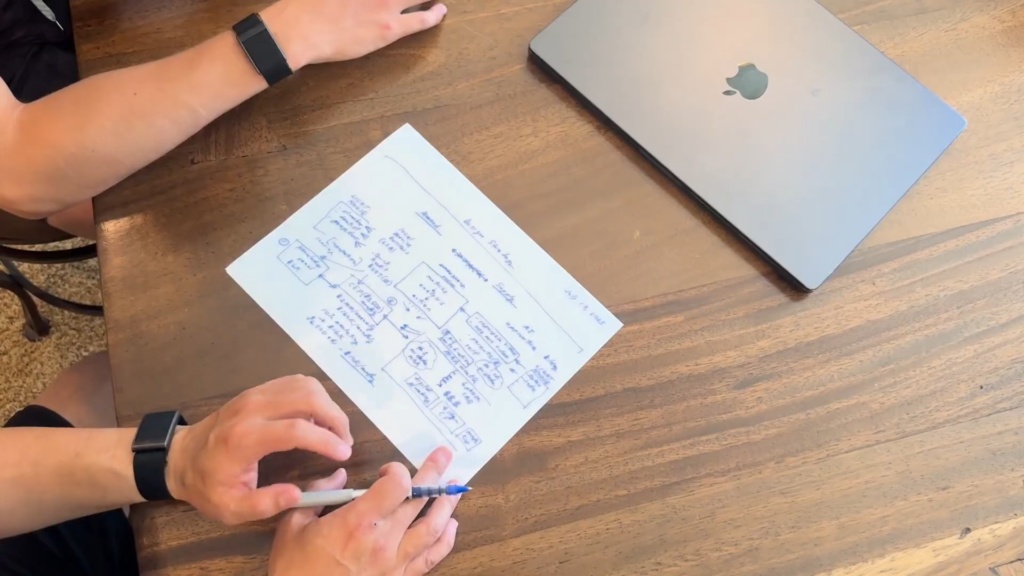
Eight minutes on a whiteboard.
That’s all it took for Dennis to lay out the entire model. No slides. No pitch deck. Just a marker, a board, and thirty years of pattern recognition. When he stepped back and capped the pen, I understood why people keep comparing what he’s building to Uber.
Uber didn’t invent cars or passengers. It connected two groups who already needed each other and built a system that made the connection work every single time. Dennis is doing the same thing with digital marketing.
On one side, local service businesses that need marketing but can’t afford a $10,000-a-month agency. On the other, young adults who want real careers in digital marketing but can’t get hired without experience. BlitzMetrics connects them.
I’ve been working alongside Dennis since January 2025. I’ve sat across the table from him in Las Vegas while he sketched campaign structures on napkins. I’ve watched him diagnose a client’s broken funnel in under three minutes on a Zoom call. None of what follows is theory. It’s what I’ve watched work.
Understand the Two-Sided Network
Traditional agencies operate like vendors. They charge a client, outsource the work, and hope nobody asks too many questions about who’s actually doing the execution. Dennis identified this flaw fifteen years ago and built something different.
His model pairs local service businesses (plumbers, roofers, dentists, HVAC companies) with certified AI apprentices who execute real campaigns under direct supervision. The businesses get marketing they can measure. The apprentices get paid experience, certifications, and a career track where compensation rises with the results they produce.
That’s the Uber parallel. Riders need transportation. Drivers need income. The platform makes it work. Except here, the “drivers” don’t stay at the same level forever. They learn, execute, prove competency, and graduate into roles where they train the next cohort.
See the Lighthouses
Dennis calls his proven success stories “lighthouses.” They’re the clients and apprentices who demonstrate the model works, so everyone else can follow the path instead of figuring it out alone.
Roger Wakefield became America’s most prominent plumber on social media by following the Content Factory process. He didn’t hire a PR firm. He filmed one-minute videos answering questions his customers already asked, ran those through the six-stage system, and built an audience that other plumbers now study. When a plumber in Dallas sees what Roger did, they don’t need a sales pitch. They need the same playbook.
Johns Hopkins University ran a multi-week program where students partnered with small Baltimore businesses and used BlitzMetrics frameworks to generate real leads with real ad budgets. Students weren’t writing mock proposals. They were running live campaigns by week two.
Ashley Furniture, the Golden State Warriors, Nike, Red Bull, State Farm. Dennis spent over a billion dollars on Facebook and Google ads for brands like these during his years as a search engine engineer. Those aren’t name drops. They’re the testing ground where every checklist got pressure-tested before being compressed into something a 19-year-old apprentice can run.
Each of those lighthouses started the same way: one person filming a one-minute video, one checklist at a time.
Learn the Three Systems That Make It Run
The lighthouses didn’t succeed because they had bigger budgets or better luck. They succeeded because they ran the same three systems Dennis built and refined over three decades. I’ve used all three, and I’ve trained my team on each one.
The Content Factory
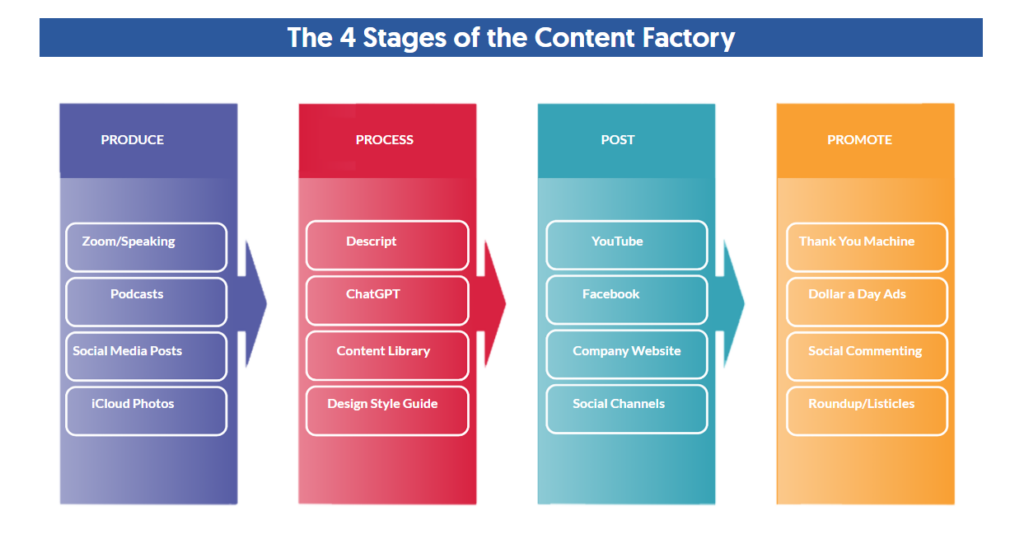
This is the engine. Every meeting, podcast, testimonial, or FAQ a business owner records moves through six stages of the Content Factory:
- Plumbing: set up tracking, analytics, pixels, Google Business Profile, schema markup
- Produce: the owner films raw content (this is the one thing only they can do)
- Process: AI tools and trained apprentices transform raw footage into articles, clips, posts
- Post: distribute across website, YouTube, social, email
- Promote: amplify winners with Dollar-a-Day advertising
- Perform: track results through weekly MAA reports, feed winners back into the cycle
The owner’s role is stage two. The system handles everything else. That’s how a single plumber interview becomes thirty pieces of content across eight platforms without the plumber touching a keyboard.
Dollar-a-Day Advertising
This isn’t a Facebook hack. It’s structured testing at $1 per day per audience segment. You boost the organic content that already performs, test it against narrow audiences, and scale only what the data confirms works. Dennis refined this approach across campaigns for brands spending millions per month, then compressed the logic into a checklist any trained apprentice can execute.
MAA: Metrics, Analysis, Action
Every Friday, every team member submits an MAA report. Not a task list. Not “I did this and that.” Three columns: what the numbers actually say, what they mean, and what specific action follows with a name and a deadline attached. Dennis taught me that most people can pull numbers. Very few can interpret them. And almost nobody converts interpretation into a concrete next step.
MAA creates the accountability loop that holds everything together. Without it, the Content Factory produces content nobody measures. Dollar-a-Day spends money nobody tracks. The apprentices do work nobody evaluates. MAA is what makes the whole system run.
Watch How Apprentices Become Specialists
The AI Apprentice program isn’t a course you watch and forget. Dennis built it on his Learn, Do, Teach methodology, and every stage requires proof.
First, you learn the frameworks: GCT (Goals, Content, Targeting), the nine triangles, Content Factory, Digital Plumbing, MAA. Then you execute on real client campaigns with direct oversight. Then you teach the system to someone newer than you. If you can’t teach it clearly, you haven’t learned it well enough to run it independently.
Bill Parker, one of our current AI Apprentices, is the highest-performing member of the program. He didn’t start with a marketing background. He started with the checklists, proved he could execute them, and now produces weekly MAA reports that Dennis reviews and approves. His work directly drives client content pipelines.
Certification demands demonstrated skills: creating one-minute WHY videos, repurposing content into blog posts, conducting live audits, and submitting weekly MAA reports. You prove every competency through doing, not through multiple choice.
See Why This Article Exists
AI and software development agencies reach out to Dennis constantly. They see the content, they understand the model, and they want in. Dennis told our team: “We want to point them to this article as a screening filter. The best people self-qualify by demonstrating they understand what we’re doing and why.”
If you’ve read this far and you can connect the two-sided network to the Content Factory to the lighthouse model to the apprentice pipeline, you’re tracking. If you can explain how MAA creates accountability across all of them, you’re ahead of 90% of the agencies that email Dennis asking to “partner.”
Here’s the bar: we don’t work with people who need the vision explained twice. We work with people who read this, see where they fit, and show up with a WHY video and a plan.
Google figured out something similar when they rolled out the Helpful Content Update and added Experience to E-A-T. The content that survives is content produced by people who’ve actually done the work. Geo-tagged photos from real job sites. Video of real client conversations. Articles written by people who ran the campaigns they describe.
Dennis doesn’t write about E-E-A-T. He builds systems that produce it at scale.
Start Here
If you’re a local service business owner generating $2 million or more annually and you want marketing that actually connects to revenue, here’s the path:
- Run a $297 Quick Audit to diagnose where you stand
- Get your Digital Plumbing in place (tracking, analytics, profiles)
- Film your first WHY video: 60 seconds, on your phone, answering “why do you do what you do?”
- Enter the Content Factory and let the system turn your raw footage into a library of searchable, promotable content
If you’re a young adult who wants a real career in digital marketing, not an internship, not a simulation, but a paid role where the team measures your results every Friday, look at the AI Apprentice program. Study the Content Factory process. Submit your application with a WHY video. And be ready to prove you can learn, do, and teach.
I’m 21 years old. I’ve been building High Rise Influence alongside Dennis for just over a year. In that time, I’ve helped produce over 400 articles for clients, trained team members on every stage of the Content Factory, closed Knowledge Panel Sprints, and built the AI Apprentice pipeline from our side. Everything I know about scaling digital marketing careers came from doing it inside this system.
Dennis has achieved roughly 25% of his goal of creating a million digital marketing jobs. The remaining 75% is what the two-sided network was built to handle. If you’re reading this and thinking about where you’d fit, that’s exactly the point.
Learn more about the Content Factory framework — the 6-stage system behind everything we do at High Rise Influence.